

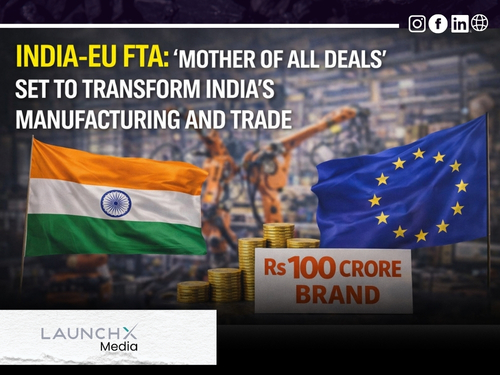

India-EU FTA: “Mother of All Deals” Set to Transform India’s Manufacturing and Trade
India-EU FTA: 7 Powerful Benefits for Manufacturing and Global Trade
India and the European Union have taken a historic step with the signing of the India-EU Free Trade Agreement (FTA), a pact that spans 25% of global GDP and 13% of global trade. Prime Minister Narendra Modi, addressing the nation, described it as the “Mother of All Deals,” highlighting its potential to boost India’s manufacturing, exports, and global competitiveness.
- India-EU FTA: 7 Powerful Benefits for Manufacturing and Global Trade
- Key Highlights of the India-EU FTA
- 1. Massive Global Economic Footprint
- 2. Boost for India’s Manufacturing Sector
- 3. Enhanced Export Opportunities
- 4. Investment and Economic Collaboration
- Implications for India’s Economy
- Challenges and Considerations
- Lessons for Businesses
- The Road Ahead
- FAQs (10)
This landmark agreement is expected to reshape trade dynamics, enhance investment flows, and strengthen economic ties between India and Europe, marking a milestone in India’s global trade journey.

Key Highlights of the India-EU FTA
1. Massive Global Economic Footprint
The FTA covers a combined economic size that represents:
25% of global GDP
13% of global trade
This positioning not only strengthens bilateral relations but also integrates India into a broader global supply chain.
2. Boost for India’s Manufacturing Sector
PM Modi emphasized that the agreement will:
Encourage domestic production and local manufacturing.
Facilitate technology transfer and joint ventures with European companies.
Create jobs and enhance skill development across sectors.
3. Enhanced Export Opportunities
The FTA opens doors for Indian exporters by:
Reducing tariffs on goods exported to EU nations.
Providing preferential access for sectors such as textiles, pharmaceuticals, and electronics.
Strengthening India’s position as a global manufacturing hub.
4. Investment and Economic Collaboration
The deal aims to attract EU investments in India, with benefits including:
Capital inflows for innovation and infrastructure.
Opportunities for Indian SMEs to expand globally.
Strategic partnerships in high-value sectors like EVs, green energy, and advanced manufacturing.

Implications for India’s Economy
Strengthening the Make in India Initiative
The FTA aligns with the government’s Make in India strategy by promoting domestic production and export-oriented manufacturing.
Global Supply Chain Integration
India can now play a larger role in global supply chains, especially in sectors like:
Automotive and EV components
Electronics and high-tech manufacturing
Pharmaceuticals and medical devices
Opportunities for SMEs
Small and medium enterprises will benefit from:
Easier market access in EU countries
Competitive export opportunities
Capacity building and collaboration with European firms

Challenges and Considerations
While the FTA offers significant opportunities, stakeholders must navigate:
Regulatory and compliance alignment with EU standards.
Competition from established European manufacturers.
Need for infrastructure upgrades to meet export demand.
Industry experts suggest that proactive government support and strategic investments will be critical to fully leveraging the FTA’s potential.
Lessons for Businesses
Align with global standards: Compliance with EU regulations is key.
Focus on competitive manufacturing: Invest in quality, technology, and efficiency.
Explore export potential: Identify sectors with high demand in Europe.
Leverage partnerships: Collaborate with EU firms for joint ventures and knowledge transfer.
Adapt strategically: Plan for phased scaling to manage risks and maximize benefits.
The Road Ahead
The India-EU FTA is more than a trade agreement; it is a strategic partnership that can redefine India’s role in global commerce. By boosting exports, attracting investments, and strengthening manufacturing, the deal is poised to create new economic opportunities and accelerate India’s growth trajectory.
For businesses, the message is clear: adapt, innovate, and leverage the FTA to compete successfully on the global stage.

FAQs (10)
What is the India-EU FTA?
A historic free trade agreement between India and the European Union covering 25% of global GDP and 13% of global trade.Why did PM Modi call it the “Mother of All Deals”?
Because it represents a landmark agreement with massive economic impact for India’s manufacturing, exports, and global trade.Which sectors benefit most from the FTA?
Textiles, pharmaceuticals, electronics, automotive, EV components, and high-tech manufacturing sectors.How will Indian SMEs benefit?
They gain preferential market access in the EU, opportunities for exports, and potential collaborations with European companies.What impact will this have on India’s Make in India initiative?
It will strengthen domestic manufacturing, promote technology adoption, and create jobs in key sectors.Will the FTA attract EU investments to India?
Yes, it is expected to encourage capital inflows in manufacturing, infrastructure, and innovation-driven sectors.How does the FTA affect tariffs?
It will reduce or eliminate tariffs on a range of goods exported from India to EU countries.Are there challenges for Indian businesses?
Yes, including compliance with EU standards, competition from European manufacturers, and infrastructure readiness.Can this FTA boost India’s global supply chain role?
Yes, it enhances India’s participation in high-value global supply chains.When will the FTA take effect?
The timeline depends on ratification and regulatory processes in India and EU member states.