

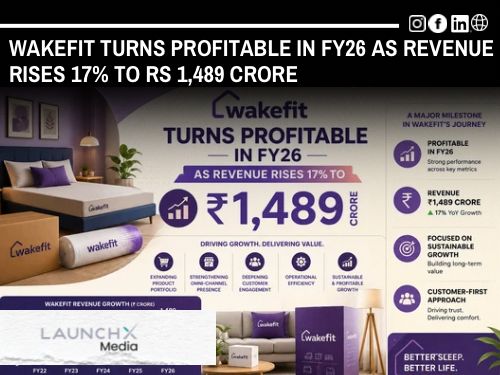

Wakefit Turns Profitable in FY26 as Revenue Rises 17% to Rs 1,489 Crore
Wakefit Turns Profitable in FY26 as Revenue Surges to Rs 1489 Crore
Wakefit Reaches a Major Milestone in India’s D2C Startup Ecosystem
Wakefit has achieved profitability in FY26 while reporting a strong 17% increase in revenue to Rs 1,489 crore, marking a significant milestone for the Bengaluru-based direct-to-consumer brand.
- Wakefit Turns Profitable in FY26 as Revenue Surges to Rs 1489 Crore
- Wakefit Reaches a Major Milestone in India’s D2C Startup Ecosystem
- Direct-to-Consumer Businesses Are Changing Retail
- From Sleep Solutions to Home Lifestyle Brand
- Investors Are Prioritizing Sustainable Growth
- Organized Furniture Retail Is Growing Rapidly
- Digital and Offline Retail Are Merging
- Logistics Can Be Challenging
- AI and Data Analytics Improve Customer Experiences
- D2C Brands Are Moving Beyond Growth-Only Models
- Wellness and Comfort Are Rising Priorities
- The Home and Furniture Segment Is Highly Competitive
- It Shows D2C Brands Can Achieve Scale and Profitability
- Expansion Into New Categories Could Continue
- Rising Competition Could Pressure Margins
- Consumer Brands Could Continue Expanding Rapidly
- 1. What is Wakefit?
- 2. What financial milestone did Wakefit achieve in FY26?
- 3. How much revenue did Wakefit report?
- 4. What is a D2C brand?
- 5. Why is profitability important for startups?
- 6. Why is India’s online furniture market growing?
- 7. What challenges do furniture startups face?
- 8. How does technology help D2C brands?
- 9. What is omnichannel retail?
- 10. Could India’s D2C ecosystem continue expanding?
The development highlights how India’s D2C ecosystem is evolving from aggressive growth-focused expansion toward more sustainable and profitable business models. Wakefit’s performance also reflects the increasing maturity of India’s online furniture, home lifestyle, and sleep solutions market.
Over the last few years, the company has expanded from being primarily known for mattresses and sleep products into a broader home and furniture brand. Its journey mirrors the changing behavior of Indian consumers who are increasingly comfortable purchasing large lifestyle and furniture products online.
Wakefit’s profitability milestone arrives at a time when many startups are under pressure to balance growth with financial discipline, operational efficiency, and long-term sustainability.

The Rise of D2C Brands in India
Direct-to-Consumer Businesses Are Changing Retail
D2C brands have transformed how companies interact with consumers by eliminating traditional middlemen and selling directly through digital channels.
This business model allows brands to:
- Control customer experience
- Improve pricing efficiency
- Build direct customer relationships
- Collect consumer insights
- Increase brand loyalty
India’s rapidly expanding digital economy has accelerated the growth of D2C businesses across categories such as:
- Furniture
- Fashion
- Beauty
- Home decor
- Consumer electronics
- Wellness products
Consumers Are Becoming More Digital-First
The rise of:
- Smartphones
- Affordable internet
- Digital payments
- E-commerce adoption
has fundamentally changed shopping behavior in India.
Consumers now increasingly research, compare, and purchase products online, including traditionally offline-heavy categories like furniture and mattresses.
Wakefit’s Growth Story Reflects Changing Consumer Trends
From Sleep Solutions to Home Lifestyle Brand
Wakefit initially gained popularity through its sleep-focused products such as mattresses and pillows.
Over time, the company expanded into:
- Furniture
- Home decor
- Modular solutions
- Lifestyle products
This diversification helped broaden its customer base and revenue streams.
Home Improvement Spending Is Increasing
Indian consumers are spending more on:
- Home comfort
- Interior aesthetics
- Smart furniture
- Wellness-oriented products
Remote work trends and evolving urban lifestyles have further accelerated demand for home improvement products.
Why Profitability Matters for Startups
Investors Are Prioritizing Sustainable Growth
In recent years, startup ecosystems globally have shifted focus from:
- rapid expansion at all costs
toward:
- operational efficiency
- profitability
- sustainable scaling
Wakefit’s profitability milestone is important because it demonstrates that D2C brands can achieve both growth and financial stability.
Profitability Builds Long-Term Confidence
Profitable startups generally gain advantages such as:
- stronger investor confidence
- better operational flexibility
- reduced dependency on external capital
- improved resilience during market slowdowns
This becomes particularly valuable during uncertain economic conditions.
India’s Furniture and Home Market Is Expanding
Organized Furniture Retail Is Growing Rapidly
India’s furniture market has traditionally been fragmented and dominated by offline local stores.
However, organized and online furniture retail is expanding due to:
- improved logistics
- digital trust
- easier financing options
- wider product selection
Consumers increasingly value convenience and transparent pricing.
E-Commerce Is Reshaping Furniture Buying
Earlier, customers hesitated to buy furniture online because they wanted physical product interaction.
Today, improved:
- return policies
- product visualization
- customer reviews
- delivery infrastructure
have increased confidence in online furniture purchases.
Omnichannel Retail Is Becoming Important
Digital and Offline Retail Are Merging
Modern D2C brands increasingly use omnichannel strategies that combine:
- online stores
- mobile apps
- physical experience centers
- offline retail partnerships
This helps improve customer trust and brand visibility.
Physical Stores Still Matter
Even digitally native brands are investing in offline experiences because customers often prefer to:
- test furniture quality
- experience comfort levels
- visualize home products physically
before making larger purchases.
Operational Efficiency Is Critical in Furniture Businesses
Logistics Can Be Challenging
Furniture businesses face unique operational challenges such as:
- bulky product transportation
- warehousing complexity
- installation coordination
- returns management
Managing these operations efficiently is critical for profitability.
Manufacturing Optimization Improves Margins
Companies that optimize:
- sourcing
- production
- inventory management
- delivery systems
can improve cost efficiency and profit margins significantly.
Technology Is Transforming the Furniture Industry
AI and Data Analytics Improve Customer Experiences
Modern D2C brands increasingly use:
- AI recommendations
- predictive analytics
- customer behavior tracking
- inventory forecasting
to improve personalization and operational efficiency.
Augmented Reality Could Shape Future Shopping
Emerging technologies like augmented reality allow consumers to:
- visualize furniture in their homes
- compare layouts
- experiment with designs digitally
This may further accelerate online furniture adoption.
India’s Startup Ecosystem Is Becoming More Mature
D2C Brands Are Moving Beyond Growth-Only Models
Many Indian startups initially focused heavily on:
- customer acquisition
- market share expansion
- rapid scaling
Now, profitability and unit economics are becoming more important performance indicators.
Financial Discipline Is Becoming Essential
Investors increasingly evaluate startups based on:
- operational efficiency
- retention rates
- customer lifetime value
- profit potential
Sustainable business models are receiving greater attention.
Consumer Lifestyle Trends Are Supporting Wakefit’s Growth
Wellness and Comfort Are Rising Priorities
Modern consumers increasingly prioritize:
- sleep quality
- ergonomic furniture
- healthy living environments
- home comfort
This trend supports demand for premium home and sleep products.
Urbanization Is Driving Home Product Demand
As urban populations grow, demand increases for:
- space-efficient furniture
- modern interiors
- multifunctional home products
This creates long-term opportunities for home-focused brands.
Competition in India’s D2C Market Remains Intense
The Home and Furniture Segment Is Highly Competitive
Wakefit competes with:
- traditional furniture retailers
- online marketplaces
- emerging D2C brands
- premium lifestyle companies
Differentiation becomes critical in crowded markets.
Brand Loyalty Plays an Important Role
Strong customer experience and product quality help build:
- repeat purchases
- customer referrals
- long-term brand trust
These factors are important for sustainable growth.
Why Wakefit’s Performance Matters for India’s Startup Ecosystem
It Shows D2C Brands Can Achieve Scale and Profitability
Wakefit’s financial performance may encourage greater investor confidence in:
- consumer brands
- home lifestyle startups
- e-commerce businesses
especially those focused on sustainable growth.
Indian Consumers Are Embracing Branded Lifestyle Products
The rise of organized D2C brands reflects broader changes in consumer behavior where buyers increasingly seek:
- convenience
- consistent quality
- trusted digital experiences
This transformation is reshaping India’s retail landscape.
Future Growth Opportunities for Wakefit
Expansion Into New Categories Could Continue
The company may continue exploring opportunities across:
- smart furniture
- home technology
- wellness products
- modular interiors
Diversification could strengthen long-term growth.
Tier-2 and Tier-3 Cities Offer Major Potential
Growing internet penetration and rising incomes in smaller cities create opportunities for:
- online furniture adoption
- lifestyle product demand
- digital commerce expansion
These markets could become important growth drivers.

Challenges Facing D2C Furniture Brands
Rising Competition Could Pressure Margins
As more brands enter the market, companies may face:
- higher marketing costs
- pricing pressure
- customer retention challenges
Operational efficiency becomes increasingly important.
Supply Chain Disruptions Can Impact Operations
Furniture businesses rely heavily on:
- raw material sourcing
- manufacturing networks
- logistics systems
Any disruption can affect profitability and delivery timelines.
The Future of India’s D2C Ecosystem
Consumer Brands Could Continue Expanding Rapidly
India’s D2C market is expected to evolve further due to:
- rising digital adoption
- improved logistics
- changing lifestyle preferences
- increasing online trust
More niche and specialized brands may emerge.
Profitability Could Become the New Benchmark
The next phase of India’s startup ecosystem may focus less on:
- valuation-driven growth
and more on:
- operational sustainability
- profitability
- customer retention
Wakefit’s success reflects this broader transition.
Final Thoughts
Wakefit’s achievement of profitability in FY26 alongside strong revenue growth highlights the growing maturity of India’s D2C and home lifestyle ecosystem. The company’s performance demonstrates how digitally native consumer brands can successfully scale while maintaining financial discipline.
India’s furniture and sleep solutions market continues evolving rapidly due to digital commerce adoption, changing consumer lifestyles, and increasing focus on comfort and wellness. Brands capable of combining product quality, operational efficiency, and omnichannel experiences may continue gaining market share.
As the startup ecosystem increasingly prioritizes sustainable growth and profitability, Wakefit’s journey may serve as an important example for emerging D2C brands across India.

5. FAQs (10)
1. What is Wakefit?
Wakefit is an Indian D2C brand focused on mattresses, furniture, and home lifestyle products.
2. What financial milestone did Wakefit achieve in FY26?
Wakefit turned profitable in FY26 while reporting strong revenue growth.
3. How much revenue did Wakefit report?
The company reported revenue of Rs 1,489 crore.
4. What is a D2C brand?
A D2C brand sells products directly to consumers without relying heavily on intermediaries.
5. Why is profitability important for startups?
Profitability improves sustainability, investor confidence, and long-term business stability.
6. Why is India’s online furniture market growing?
Digital adoption, improved logistics, and changing consumer behavior are driving growth.
7. What challenges do furniture startups face?
Logistics complexity, inventory management, competition, and customer acquisition costs are major challenges.
8. How does technology help D2C brands?
Technology improves personalization, inventory forecasting, and customer experiences.
9. What is omnichannel retail?
Omnichannel retail combines online and offline shopping experiences.
10. Could India’s D2C ecosystem continue expanding?
Yes, increasing internet penetration and evolving consumer preferences may support long-term growth.