

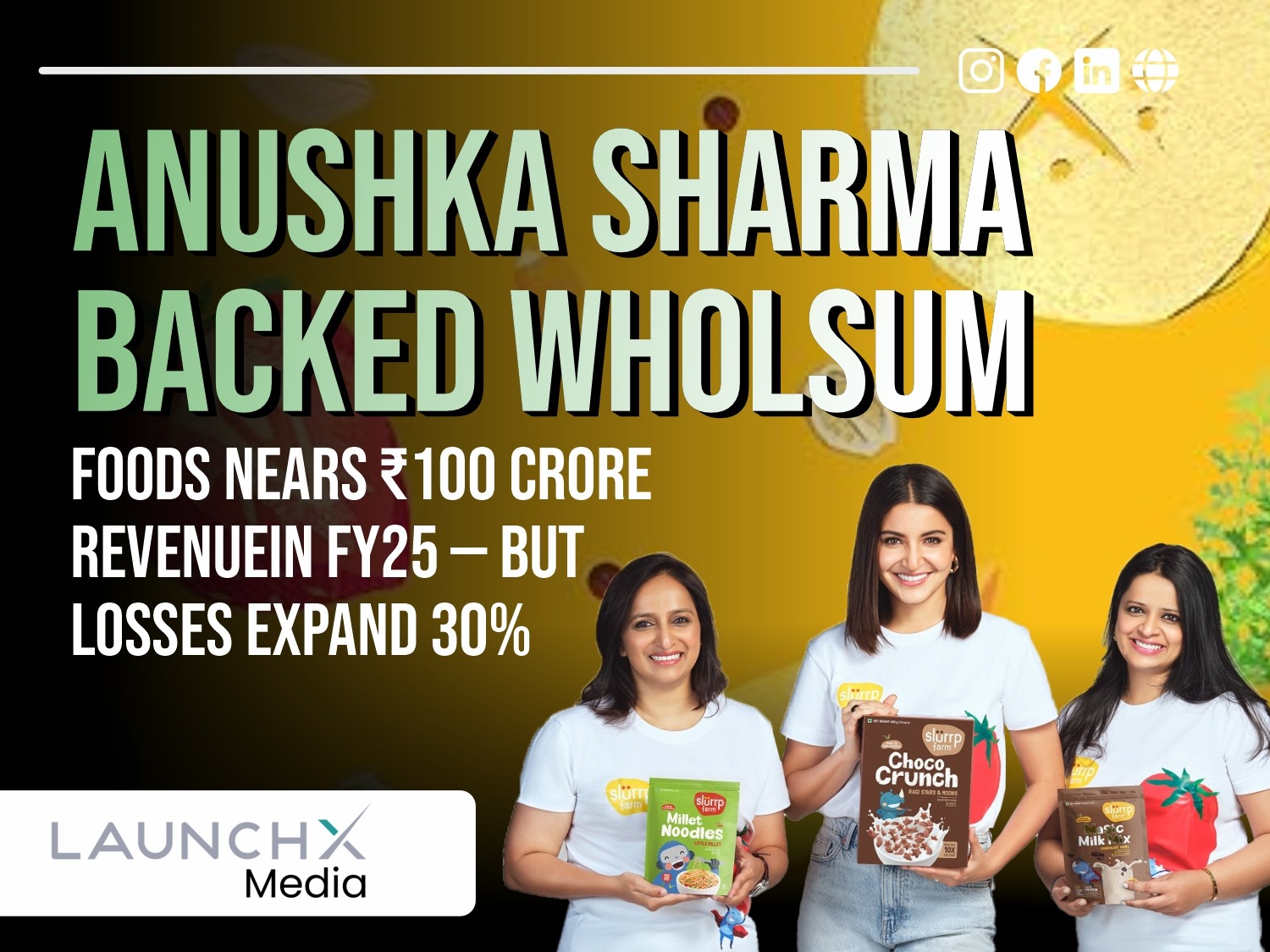

Anushka Sharma-Backed Wholsum Foods Nears ₹100 Crore Revenue in FY25 — But Losses Expand 30%
Wholsum Foods Surges to ₹100 Crore: 3 Powerful Growth Lessons Despite Rising Losses
India’s D2C food startup ecosystem continues to grow rapidly — but profitability remains elusive for many players.
- Wholsum Foods Surges to ₹100 Crore: 3 Powerful Growth Lessons Despite Rising Losses
- Revenue Growth: A Strong Push Toward ₹100 Crore
- The Other Side: Losses Widen by 30%
- The Bigger Picture: D2C Food Startups in India
- Is Growth Without Profit a Red Flag?
- The Celebrity Startup Effect: Advantage or Expectation Burden?
- What’s Next for Wholsum Foods?
- 1. Improving Gross Margins
- 2. Boosting Repeat Purchases
- 3. Strategic Category Expansion
- 4. Offline Penetration
- Final Thoughts: Revenue Milestones vs Sustainable Growth
- FAQs (10)
One of the latest examples is Wholsum Foods, the parent company of popular children-focused brand Slurrp Farm. Backed by Bollywood actor Anushka Sharma, the company has reportedly approached the ₹100 crore revenue milestone in FY25.
However, alongside impressive top-line growth, losses have widened by nearly 30%.
This raises an important question:
Is rapid revenue growth enough, or does sustainable profitability matter more in today’s startup landscape?
Let’s break it down.

Revenue Growth: A Strong Push Toward ₹100 Crore
Wholsum Foods has built its brand around healthier, millet-based and nutritious food options for children. In a market dominated by processed snacks and sugary cereals, Slurrp Farm positioned itself as a trusted alternative for modern Indian parents.
What’s Driving Growth?
1. Rising Demand for Healthy Kids’ Food
Urban Indian parents are becoming more ingredient-conscious. Millet-based products, ragi snacks, and clean-label packaged foods are gaining popularity.
The post-pandemic shift toward preventive health has further accelerated this trend.
2. Celebrity Backing and Brand Trust
The association with Anushka Sharma added aspirational value and credibility. Celebrity investors don’t just bring capital — they bring visibility.
In consumer brands, perception often drives purchase.
3. Expansion Across Channels
Wholsum Foods has strengthened its presence across:
E-commerce platforms
Quick commerce apps
Modern retail
Direct-to-consumer website
Omnichannel distribution has significantly contributed to revenue growth.
Crossing or nearing ₹100 crore revenue places the company in a strong mid-scale D2C category — a milestone many startups aspire to reach.

The Other Side: Losses Widen by 30%
While revenue growth is encouraging, the widening losses tell a more complex story.
In FY25, losses reportedly increased by around 30%. This isn’t uncommon in the D2C food industry — but it does raise strategic questions.
Why Are Losses Increasing?
1. High Customer Acquisition Costs (CAC)
Digital marketing costs continue to rise. Performance marketing, influencer collaborations, and marketplace commissions eat into margins.
2. Distribution & Logistics Costs
Food startups deal with:
Warehousing
Cold chain (in some categories)
Expiry management
Returns
These operational expenses significantly impact profitability.
3. Product Innovation & Expansion
Scaling often requires:
Launching new SKUs
Entering new categories
Investing in R&D
Expanding manufacturing capacity
These investments increase short-term losses but aim to strengthen long-term positioning.

The Bigger Picture: D2C Food Startups in India
Wholsum Foods is not alone. Many Indian D2C food brands are facing a similar pattern:
Revenue growth
High burn rate
Delayed profitability
The Indian healthy food market is expanding, but margins remain tight due to:
Competitive pricing pressure
Marketplace dependency
Rising input costs
Aggressive discounting
The real challenge isn’t building demand — it’s building sustainable unit economics.
Is Growth Without Profit a Red Flag?
Not necessarily.
In consumer startups, especially food brands, scale often precedes profitability. Investors typically focus on:
Gross margin improvement
Repeat purchase rate
Customer lifetime value (LTV)
Distribution expansion
Brand recall strength
If unit economics improve over time, temporary losses may be strategic rather than alarming.
However, in today’s funding environment — which is more cautious than the 2021 boom period — startups are under pressure to show a clear path to profitability.

The Celebrity Startup Effect: Advantage or Expectation Burden?
Celebrity-backed startups enjoy faster visibility, but they also face higher scrutiny.
Consumers expect:
Premium quality
Ethical sourcing
Transparent labeling
Strong brand values
Investors expect:
Faster scale
Strong governance
Brand defensibility
For Wholsum Foods, balancing growth with sustainable profitability will be crucial in the next 2–3 years.
What’s Next for Wholsum Foods?
To move toward profitability, the company may need to focus on:
1. Improving Gross Margins
Optimizing sourcing, manufacturing efficiency, and supply chain.
2. Boosting Repeat Purchases
Subscription models and loyalty programs can reduce CAC pressure.
3. Strategic Category Expansion
Entering adjacent categories that leverage existing brand trust.
4. Offline Penetration
Scaling in Tier-2 and Tier-3 cities where competition is lower.
If executed well, the ₹100 crore milestone could be a stepping stone toward a much larger valuation and eventual profitability.
Final Thoughts: Revenue Milestones vs Sustainable Growth
The Wholsum Foods story reflects the evolving nature of India’s startup ecosystem.
Crossing ₹100 crore revenue is a remarkable achievement — especially in the competitive D2C food space. But widening losses remind us that scale alone doesn’t guarantee success.
For founders and investors alike, the next phase of Indian startups will likely be defined by:
Capital efficiency
Strong unit economics
Brand loyalty
Operational discipline
Wholsum Foods stands at a pivotal point. The coming years will determine whether it transitions from a fast-growing brand to a sustainably profitable one.
And for the broader ecosystem, the lesson is clear:
Growth is impressive. Profitability is powerful.

FAQs (10)
What is Wholsum Foods?
Wholsum Foods is an Indian D2C food startup and the parent company of Slurrp Farm.Who invested in Wholsum Foods?
The company is backed by actress Anushka Sharma, among other investors.What is Wholsum Foods’ FY25 revenue?
The company is nearing the ₹100 crore revenue mark in FY25.Why did Wholsum Foods’ losses increase?
Due to rising marketing costs, expansion expenses, and operational investments.Is Slurrp Farm profitable?
While revenue is growing, losses have widened, indicating profitability is still a work in progress.What products does Slurrp Farm sell?
Healthy, millet-based and nutritious food products primarily targeted at children.Why do D2C food startups struggle with profitability?
High CAC, logistics costs, marketplace commissions, and competitive pricing impact margins.Is the Indian healthy food market growing?
Yes, demand for clean-label and nutritious packaged foods is increasing steadily.What does ₹100 crore revenue mean for a startup?
It signals strong market acceptance and mid-scale growth maturity.Can celebrity-backed startups sustain long-term growth?
Yes, if they combine brand appeal with operational discipline and strong unit economics.


