

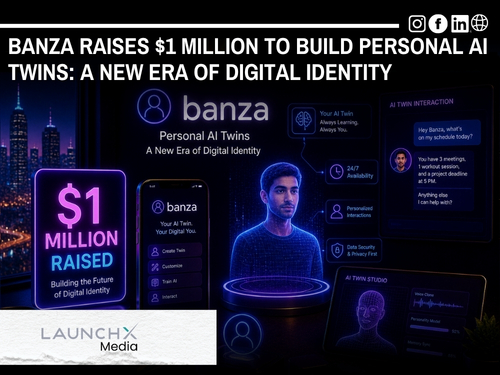

Banza Raises $1 Million to Build Personal AI Twins: A New Era of Digital Identity
Banza Funding News: $1M Boost to Redefine Personal AI Ownership
Artificial intelligence is no longer just about chatbots or automation—it’s rapidly evolving into something far more personal. In a major step toward this future, AI startup Banza has raised $1 million in funding to help individuals build and own their very own “AI twin.”
This development marks a shift in how we interact with technology. Instead of using generic AI tools, users may soon have personalized digital versions of themselves—trained on their data, preferences, and behaviors.
But what exactly is an AI twin, and why are investors betting on this concept? Let’s break it down.
What Is a Personal AI Twin?
Beyond Chatbots: A Digital Extension of You
A personal AI twin is essentially a digital version of yourself powered by artificial intelligence. It can:
- Mimic your communication style
- Understand your preferences
- Assist with tasks on your behalf
- Act as a digital representative in certain scenarios
Unlike traditional AI assistants, which are generic, AI twins are deeply personalized and evolve over time.

Ownership Is the Key Differentiator
One of Banza’s core ideas is ownership. Instead of relying on centralized platforms that control user data, Banza aims to give individuals full control over their AI twin.
This means users can:
- Decide how their data is used
- Customize their AI’s behavior
- Potentially monetize their digital identity
This shift toward user ownership aligns with broader trends in decentralized technology and digital privacy.
The $1 Million Funding: Why It Matters
Early Confidence in a Bold Idea
Raising $1 million at an early stage indicates strong investor belief in Banza’s vision. While the concept of AI twins is still emerging, it has significant long-term potential.
Investors are likely betting on:
- The rise of personalized AI
- Increasing demand for digital identity solutions
- Future applications across industries
How Banza Plans to Use the Funds
The fresh capital will likely be used to:
- Develop and refine AI models
- Build a scalable platform
- Enhance user experience
- Expand the team and technical capabilities
This phase is crucial for turning a futuristic concept into a practical, user-friendly product.
Why Personal AI Twins Could Be the Next Big Thing
- The Shift Toward Personalization
Modern users expect technology to adapt to them—not the other way around. From content recommendations to smart assistants, personalization is already a key trend.
AI twins take this a step further by offering:
- Hyper-personalized interactions
- Context-aware responses
- Continuous learning based on user behavior
- Time-Saving and Productivity Boost
Imagine having an AI that can:
- Respond to emails in your tone
- Schedule meetings intelligently
- Handle repetitive tasks
This could significantly boost productivity, especially for professionals, entrepreneurs, and creators.
- New Opportunities in the Creator Economy
AI twins could unlock new revenue streams. For example:
- Influencers could scale engagement using AI versions of themselves
- Experts could offer AI-powered consultations
- Creators could license their AI for specific use cases
This opens up an entirely new layer of digital entrepreneurship.
Potential Use Cases Across Industries
Professional Services
Consultants, lawyers, and coaches could use AI twins to provide 24/7 support to clients.
Education and EdTech
Students could interact with AI versions of teachers or mentors, making learning more accessible and personalized.
Customer Support
Businesses could deploy AI twins of their representatives to handle customer queries efficiently.
Personal Life Management
From managing schedules to offering reminders, AI twins could become an integral part of daily life.

Challenges and Concerns Around AI Twins
- Data Privacy and Security
Building an AI twin requires access to personal data. Ensuring this data is secure and used ethically will be critical.
- Ethical Questions
If an AI can replicate your personality, where do we draw the line? Questions around identity, consent, and misuse will need clear answers.
- Technology Limitations
Creating a truly accurate AI twin is complex. It requires advanced machine learning models and continuous improvement.
Banza’s Business Model: What Could It Look Like?
Subscription-Based Platform
Users may pay a monthly fee to create and maintain their AI twin, with different tiers based on features.
Marketplace for AI Twins
Banza could potentially build a marketplace where users can:
- Share or license their AI
- Collaborate with others
- Access specialized AI twins
Enterprise Solutions
Businesses could use Banza’s technology to create AI representatives for employees, enhancing scalability and efficiency.
The Bigger Picture: AI Is Becoming Personal
Banza’s vision reflects a broader transformation in artificial intelligence. We are moving from:
- Generic AI tools → Personalized AI systems
- Centralized control → User ownership
- Passive assistants → Active digital counterparts
This evolution could redefine how humans interact with technology.
Future Outlook: What’s Next for Banza?
With $1 million in funding, Banza is still in its early stages—but the potential is massive. If executed well, the startup could:
- Pioneer the AI twin category
- Attract global users
- Influence how digital identity is managed
However, success will depend on building trust, ensuring privacy, and delivering real value to users.
Official Website of Banza
https://www.banza.ai

- FAQs (10)
- What is Banza?
Banza is an AI startup focused on helping users create and own their personal AI twins. - How much funding has Banza raised?
Banza has raised $1 million in its latest funding round. - What is a personal AI twin?
It is a digital version of a person powered by AI that mimics their behavior and preferences. - How can AI twins be used?
They can assist with tasks, communication, productivity, and digital representation. - Is Banza’s AI safe to use?
The company aims to prioritize user ownership and data privacy, though safeguards will be crucial. - Who can benefit from AI twins?
Professionals, creators, businesses, and everyday users. - Can AI twins replace humans?
No, they are designed to assist and enhance human capabilities, not replace them. - What industries can use AI twins?
Education, customer support, professional services, and content creation. - What challenges does Banza face?
Privacy concerns, ethical issues, and technological complexity. - Is personal AI the future?
Many experts believe personalized AI will play a major role in the future of technology.


