

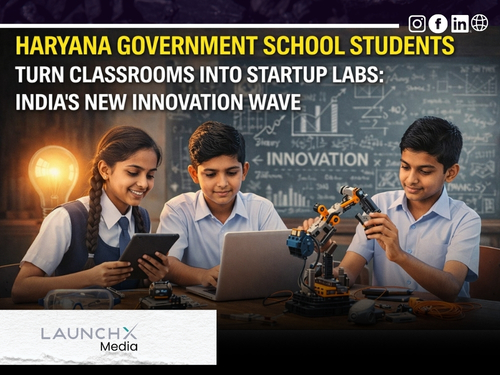

Haryana Government School Students Turn Classrooms into Startup Labs: India’s New Innovation Wave
Haryana Startup Labs in Schools: 9 Amazing Benefits for Student Innovation
In a remarkable shift from traditional classroom learning, government school students in Haryana are transforming their classrooms into startup labs. This move is not only redefining education but also shaping a future where innovation, entrepreneurship, and practical skills become part of the daily curriculum.
- Haryana Startup Labs in Schools: 9 Amazing Benefits for Student Innovation
- Why Haryana’s Startup Lab Initiative Matters
- The Classroom as a Startup Lab: What’s Changing?
- What Students Are Building in Haryana’s Startup Labs
- 1. Tech-Based Solutions
- 2. Environment & Sustainability Projects
- 3. Healthcare and Community Projects
- 4. Engineering and Prototype Models
- The Impact on Students and the Community
- Why This Model Should Expand Across India
From building simple prototypes to developing solutions for real-world problems, these students are experiencing a new kind of education—one that encourages creativity, risk-taking, and problem-solving. This is not just a school initiative; it is a blueprint for India’s next generation of innovators.
Why Haryana’s Startup Lab Initiative Matters
India’s startup ecosystem is thriving, but it still needs a strong foundation of young innovators. Haryana’s initiative is a bold step toward building that foundation. The program aims to:
Introduce students to entrepreneurship early
Build a culture of innovation and experimentation
Teach practical skills such as coding, designing, and prototyping
Encourage students to solve local problems with local solutions
This initiative aligns perfectly with India’s national push for innovation and entrepreneurship, especially through programs like Atal Innovation Mission and other government schemes.

The Classroom as a Startup Lab: What’s Changing?
From Books to Prototypes
Traditional education focuses mainly on textbooks and exams. However, the startup lab approach introduces students to hands-on learning. Students work on projects that require:
Research
Designing
Testing
Iteration
Presentation
This process mimics real-world startup development and helps students understand the value of persistence and experimentation.
From Theory to Real-World Problem Solving
The most exciting part of this initiative is that students are not just learning; they are solving real problems. Whether it is a local issue like water conservation or community health, students are encouraged to build solutions that can make a real impact.

What Students Are Building in Haryana’s Startup Labs
The projects in these startup labs range from simple models to more advanced innovations. Some common types of projects include:
1. Tech-Based Solutions
Students learn basic coding and build simple apps or automation tools to solve everyday problems.
2. Environment & Sustainability Projects
From solar-powered models to waste management solutions, students are creating eco-friendly innovations.
3. Healthcare and Community Projects
Students work on ideas that address local healthcare issues, including awareness campaigns and basic medical tools.
4. Engineering and Prototype Models
Students design and build prototypes like drones, robots, and mechanical systems using everyday materials.
The Impact on Students and the Community
This startup lab model is creating a powerful impact:
Boosting Student Confidence
Students who once felt limited by traditional education are now more confident and ambitious. They are learning to take risks, face challenges, and believe in their ideas.
Building Future-Ready Skills
Skills like critical thinking, creativity, teamwork, and problem-solving are becoming the new “must-haves” for students.
Community Empowerment
Local communities benefit from student-led solutions that address real issues, such as waste management, water conservation, and health awareness.

Why This Model Should Expand Across India
Haryana’s initiative is a proof of concept for the future of education in India. If replicated across the country, it can:
Create a generation of problem solvers
Reduce unemployment through entrepreneurial skills
Strengthen India’s innovation ecosystem
Build a stronger connection between education and real-world needs
The model also supports the national vision of “Make in India” and “Startup India” by nurturing grassroots innovation.
Conclusion: The Classroom of Tomorrow Is Here
Haryana’s government school startup labs are more than a learning experiment. They are a transformation in how India educates its youth. By turning classrooms into innovation hubs, Haryana is setting a powerful example for the rest of the country.
This initiative proves that entrepreneurship is not limited to cities or private schools—it can start anywhere, even in government classrooms.
The future of India’s startup ecosystem may very well begin here, with students who are learning to think like innovators from day one.

FAQs
What are startup labs in Haryana government schools?
Startup labs are classroom spaces where students learn entrepreneurship, innovation, and practical skills through project-based learning.Why are startup labs important in schools?
They promote creativity, problem-solving, and real-world skills that help students become future-ready.What projects do students build in these labs?
Projects include tech solutions, sustainability models, healthcare innovations, and engineering prototypes.Which skills do students gain from startup labs?
Students learn coding basics, teamwork, design thinking, research, and presentation skills.How does this initiative support the Startup India mission?
It nurtures early-stage entrepreneurship and builds a strong foundation for India’s future startup ecosystem.Are these startup labs only for urban schools?
No. The initiative is designed for government schools across both urban and rural areas.Can students sell or scale their innovations?
Yes, students can showcase their ideas and potentially scale them through incubators or community support.How can other states adopt this model?
Other states can collaborate with innovation missions, NGOs, and government programs to replicate the lab model.What is the long-term impact of startup labs?
Long-term impacts include increased innovation, entrepreneurship, and better employment opportunities.How do startup labs improve student confidence?
Students gain confidence by building real projects, presenting ideas, and solving community problems.


