

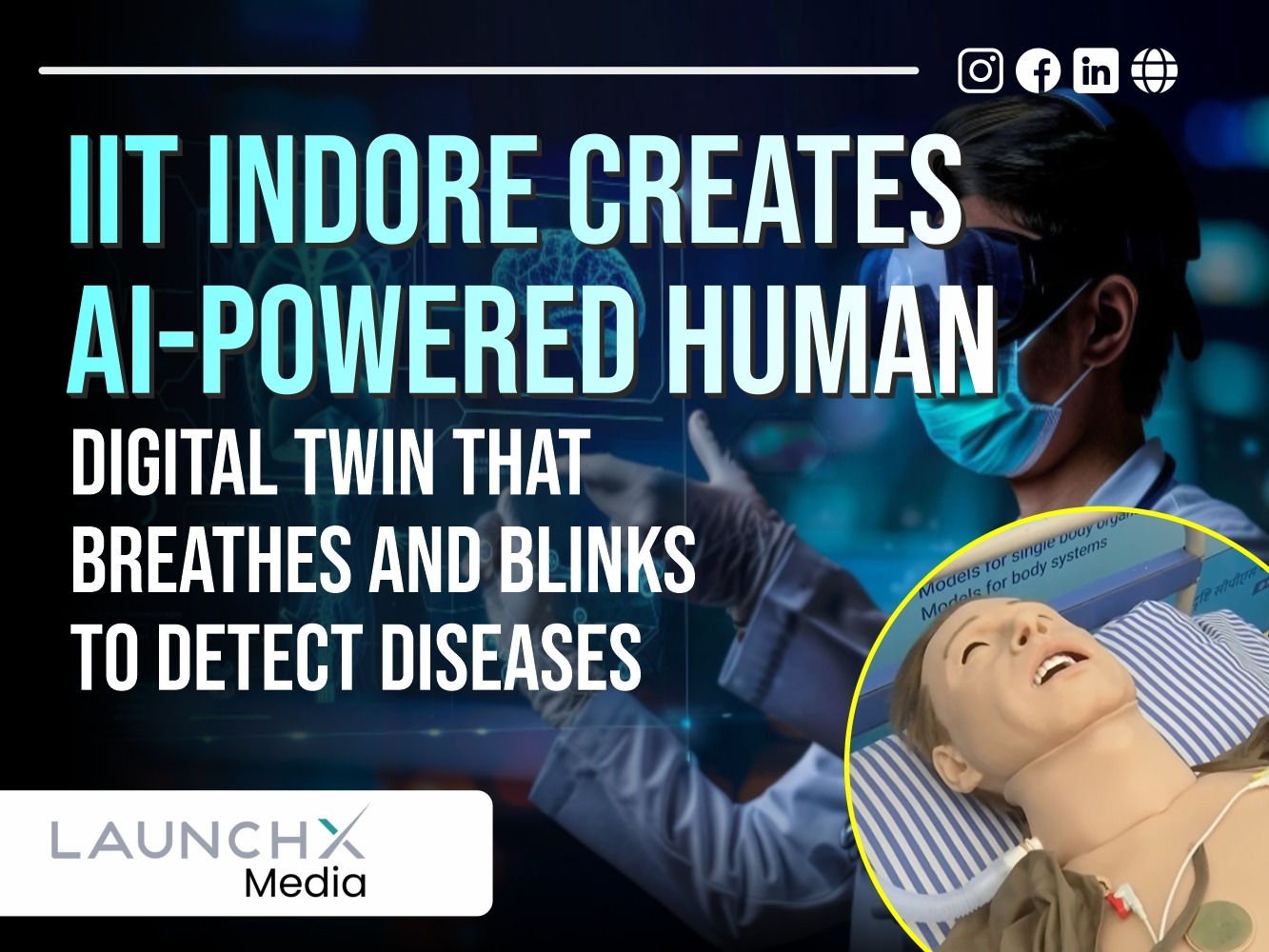

IIT Indore Creates AI-Powered Human Digital Twin That Breathes and Blinks to Detect Diseases
IIT Indores AI Human Digital Twin: 7 Powerful Ways Its Revolutionizing Disease Detection
In a remarkable leap forward for healthcare technology, IIT Indore has developed a first-of-its-kind AI-powered human digital twin backed by the Government of India. This advanced system mimics human physiology — including breathing and blinking — to detect signs of disease and potentially reshape early diagnosis.
- IIT Indores AI Human Digital Twin: 7 Powerful Ways Its Revolutionizing Disease Detection
- What Is a Human Digital Twin?
- How the AI Twin Detects Diseases
- Why This Matters for Indian Healthcare
- Government Support: Why It’s Significant
- The Science Behind the Twin: More Than a Simulation
- Challenges and Ethical Concerns
- What This Means for Patients and Doctors
- Looking Ahead: The Future of Digital Twins in Healthcare
- FAQs (10)
The project combines cutting-edge research, artificial intelligence, and deep understanding of human biology to pioneer diagnostic tools that could transform medicine as we know it.
What Is a Human Digital Twin?
Understanding the Technology
A digital twin is a virtual replica of a physical entity — in this case, the human body. While digital twins have long been used in engineering and manufacturing, applying this concept to human health is both complex and groundbreaking.
The digital twin created by IIT Indore:
Simulates breathing patterns
Mimics eye movements such as blinking
Runs real-time physiological models
Detects subtle health irregularities
This model doesn’t just respond to data — it learns and adapts, making it more accurate over time.

How the AI Twin Detects Diseases
A New Approach to Early Diagnosis
Traditional diagnostic methods often rely on snapshots — a single scan, test, or reading. The AI-powered human digital twin continuously integrates diverse data sources:
Vital signs
Imaging results
Behavioral patterns
Historical health data
By doing so, the system can detect deviations that may indicate early stages of disease, sometimes before symptoms even appear.
This opens new possibilities for:
Predictive health monitoring
Personalized medical intervention
Longitudinal disease tracking
Doctors can use the digital twin as a companion diagnostic tool, enhancing decision-making with AI insights rather than replacing human expertise.
Why This Matters for Indian Healthcare
A Step Toward Preventive Medicine
AI health tools are not just convenient — they are transformative. In India, where access to quality medical infrastructure is uneven, digital innovations like this could help bridge significant gaps.
The digital twin approach supports:
Faster diagnoses
Reduced healthcare costs
Remote monitoring for rural regions
Personalized health recommendations
This is especially crucial in managing chronic diseases like diabetes, heart disease, and respiratory conditions.

Government Support: Why It’s Significant
Backing Innovation at Scale
The Government of India’s support for this project underscores a national priority: making India a global hub for health tech innovation. Government assistance helps:
Fund extensive research
Promote data security and ethics
Facilitate collaboration with hospitals and clinics
Build scalable public-health solutions
This initiative aligns with broader national missions like Digital India, AI research advancement, and healthcare accessibility.
The Science Behind the Twin: More Than a Simulation
Breath and Blink — Not Just Symbols
The digital twin isn’t just a digital avatar — it integrates real physiological dynamics:
Breathing patterns can reveal lung and heart function abnormalities
Blink rates and reflexes may signal neurological or ocular disorders
By including these subtle biometric cues, the twin moves beyond generic models to become a sophisticated mirror of the human body.
Challenges and Ethical Concerns
Managing Data and Privacy
AI and healthcare raise important questions:
How is sensitive health data protected?
Who owns the digital health profile?
How are biases in AI models addressed?
IIT Indore and government collaborators emphasize that privacy, consent, and transparency are key pillars of the system’s design.

What This Means for Patients and Doctors
A New Era of Collaboration
This digital twin is not about replacing doctors — it’s about augmenting their capabilities. Physicians can use twin-generated insights to:
Prioritize high-risk patients
Tailor treatment plans
Predict disease trajectories
Monitor treatment outcomes with precision
For patients, this can mean earlier intervention and improved quality of life.
Looking Ahead: The Future of Digital Twins in Healthcare
Beyond Detection — Toward Prediction
The long-term vision for AI digital twins extends beyond disease detection. Future possibilities include:
Simulating treatment outcomes
Personalized drug response predictions
Health coaching based on virtual physiology
Integration with wearable health tech
As data grows, the twin becomes more intelligent, offering deeper insights into human health and disease progression.

FAQs (10)
1. What is a human digital twin?
A digital twin is a virtual model of a physical body that uses real data to simulate health and biological functions.
2. How does AI help in disease detection?
AI analyzes vast amounts of health data, identifying patterns and anomalies that can signal disease earlier than traditional methods.
3. Can this technology replace doctors?
No. It is designed to assist doctors by providing deeper insights and predictive analysis, not to replace them.
4. Are digital twins used in real medical treatment?
They are increasingly used in research and diagnostics but still emerging in mainstream clinical settings.
5. What kinds of diseases can the digital twin detect?
Early research suggests lung, heart, neurological, and chronic conditions may be identified through patterns in biometric data.
6. Is patient data safe in this system?
Data safety, privacy, and ethical use are central elements built into the platform’s design.
7. Does this technology require wearables?
Digital twin systems may integrate data from wearables but can also use clinical and medical records.
8. Can patients access their digital twin data?
Access is expected to be controlled by strict consent protocols and healthcare provider partnerships.
9. Is this technology available for public use?
Currently, it is in development and pilot phases; broader availability will depend on clinical validation and regulatory approval.
10. Will India lead in AI healthcare innovation?
With initiatives like this, India is positioning itself as a key player in AI-driven healthcare solutions globally.


