

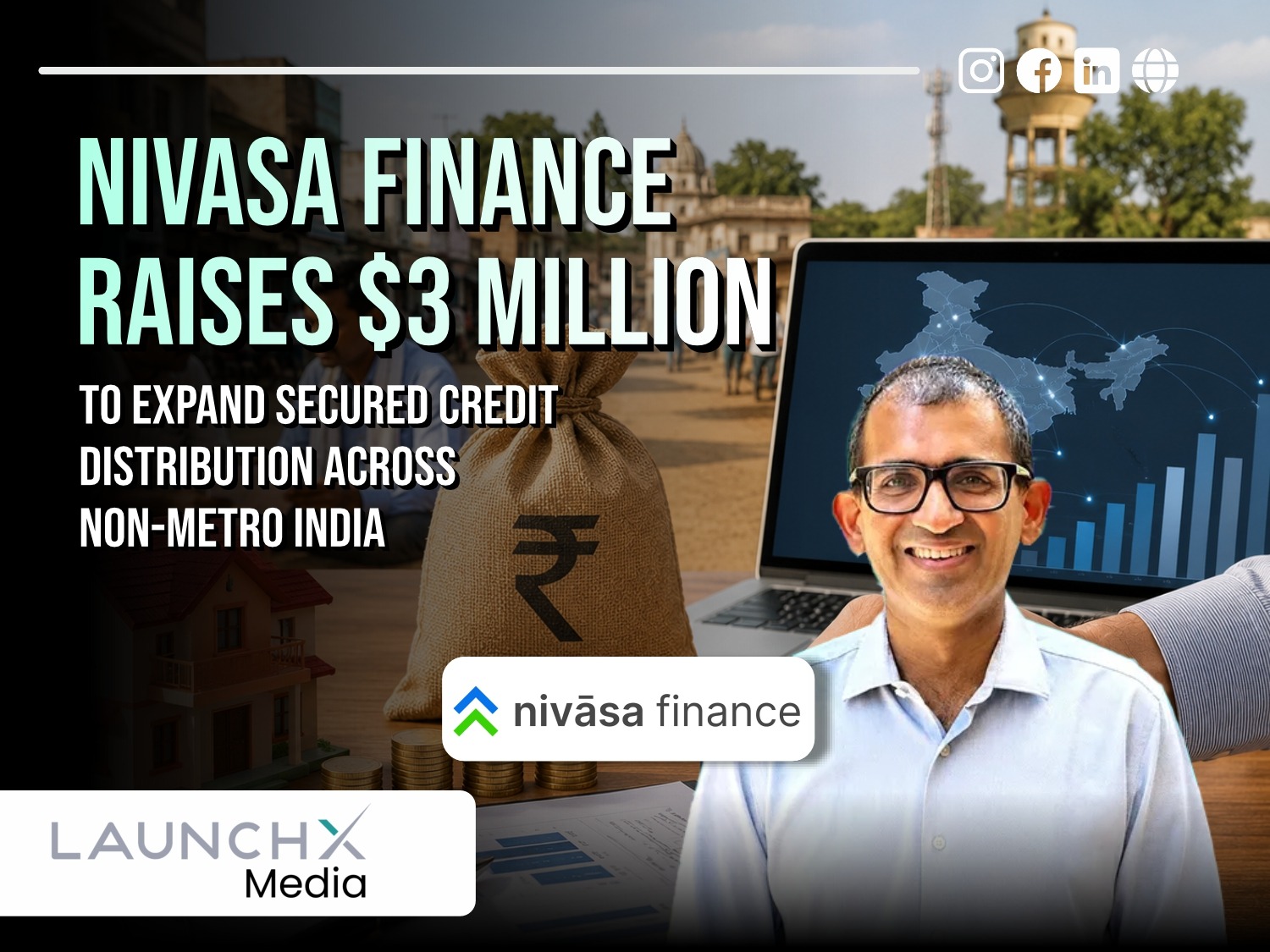

Nivasa Finance Raises $3 Million to Expand Secured Credit Distribution Across Non-Metro India
Nivasa Finance Raises $3 Million in a Major Boost for Non-Metro Lending Growth
India’s fintech ecosystem is rapidly evolving beyond major metropolitan cities, and Nivasa Finance is positioning itself at the center of this transformation. The startup has raised $3 million in fresh funding to strengthen its secured credit distribution business in India’s underserved non-metro markets.
- Nivasa Finance Raises $3 Million in a Major Boost for Non-Metro Lending Growth
- Why Non-Metro Lending Is Becoming a Massive Opportunity
- Understanding Nivasa Finance’s Business Model
- Why Investors Are Betting on Secured Credit Startups
- India’s MSME Sector Needs Better Credit Access
- Technology Is Reshaping Credit Distribution
- The Rise of Financial Inclusion Startups
- Why Secured Lending Has Long-Term Potential
- Challenges Ahead for Nivasa Finance
- Funding Likely to Accelerate Expansion Plans
- India’s Fintech Future Is Expanding Beyond Metro Cities
- Why This Funding Round Matters
- Final Thoughts
- FAQs
The funding marks an important milestone not only for the company but also for the broader financial inclusion landscape in India. While urban fintech adoption has grown significantly over the last decade, millions of individuals and small businesses in tier-2, tier-3, and rural regions still struggle to access structured credit.
Nivasa Finance aims to bridge that gap by making secured lending more accessible, technology-driven, and scalable.
The startup’s latest funding round reflects increasing investor confidence in India’s growing alternative lending ecosystem and the massive untapped potential in smaller cities and semi-urban regions.
Why Non-Metro Lending Is Becoming a Massive Opportunity
India’s economic growth is no longer concentrated only in large cities like Mumbai, Bengaluru, Delhi, or Hyderabad.
Smaller cities and emerging business hubs are now contributing significantly to:
- Consumption growth
- MSME expansion
- Digital adoption
- Entrepreneurship
- Financial activity
However, access to formal credit remains a major challenge in many non-metro regions.
Traditional banks often hesitate to lend due to:
- Limited credit history
- Documentation issues
- Informal income structures
- Geographic barriers
- High operational costs
As a result, many small businesses and individuals rely on informal lenders with higher interest rates and limited transparency.
This is where fintech companies like Nivasa Finance are creating new opportunities.

Understanding Nivasa Finance’s Business Model
Nivasa Finance operates in the secured credit segment, which generally involves loans backed by collateral or assets.
Unlike unsecured lending, secured credit reduces lender risk and can improve loan accessibility for borrowers who may not have strong formal credit profiles.
The startup focuses on creating a more efficient lending ecosystem by combining:
- Technology-driven underwriting
- Local market distribution
- Risk assessment systems
- Faster loan processing
- Financial accessibility
Its expansion strategy appears to target underserved markets where traditional financial penetration remains relatively low.
Why Investors Are Betting on Secured Credit Startups
India’s lending market is undergoing a structural shift.
Investors are increasingly focusing on startups that solve real-world financial access problems rather than only building consumer-facing apps.
Secured credit is becoming especially attractive because:
- It offers lower default risk
- Borrowers often need productive capital
- Demand remains underserved
- The market size is enormous
- Financial inclusion remains a national priority
As India’s MSME economy grows, demand for working capital, business loans, property-backed loans, and structured financing solutions is expected to rise sharply.
The $3 million funding round signals strong confidence in Nivasa Finance’s growth potential within this expanding market.
India’s MSME Sector Needs Better Credit Access
Micro, Small, and Medium Enterprises form the backbone of India’s economy.
MSMEs contribute significantly to:
- Employment generation
- Manufacturing output
- Exports
- Regional economic development
Despite their importance, many small businesses struggle to obtain timely financing.
Common challenges include:
- Lack of collateral documentation
- Delayed approvals
- Limited banking relationships
- Low financial literacy
- Inadequate digital records
Fintech startups are attempting to solve these issues through data-driven lending systems and localized credit models.
Nivasa Finance’s focus on secured lending could help create more sustainable financing structures for small businesses operating outside major urban centers.
Technology Is Reshaping Credit Distribution
India’s digital infrastructure growth is transforming the lending industry.
Fintech companies now leverage:
- Digital KYC systems
- Alternative credit scoring
- AI-driven underwriting
- Real-time risk analysis
- Digital payment ecosystems
- Automated loan workflows
These innovations allow startups to serve borrowers faster and more efficiently than traditional institutions.
AI and Data Analytics in Lending
Artificial intelligence is increasingly becoming central to modern lending operations.
AI tools help lenders:
- Analyze borrower behavior
- Assess repayment capacity
- Detect fraud risks
- Improve underwriting accuracy
- Personalize loan products
As fintech adoption expands, AI-driven lending systems are expected to play a major role in scaling financial inclusion across India.
The Rise of Financial Inclusion Startups
India has witnessed explosive growth in digital finance over the last decade.
UPI adoption, digital banking, Aadhaar-linked services, and mobile internet penetration have created fertile ground for fintech innovation.
But financial inclusion still remains incomplete.
Millions of people in smaller cities and rural regions remain underserved when it comes to:
- Business financing
- Credit products
- Insurance access
- Wealth management
- Structured financial services
This gap is creating opportunities for startups focused on grassroots financial infrastructure.
Nivasa Finance appears to be targeting exactly this segment.
Why Secured Lending Has Long-Term Potential
While unsecured digital lending saw rapid growth in recent years, the sector also faced rising concerns related to:
- High defaults
- Aggressive recovery practices
- Regulatory scrutiny
- Risk management failures
Secured lending offers a more balanced and sustainable approach.
By linking loans to assets or collateral, lenders can:
- Improve risk management
- Reduce non-performing assets
- Offer larger ticket sizes
- Maintain healthier loan books
This model may become increasingly important as regulators focus on responsible lending practices.

Challenges Ahead for Nivasa Finance
Despite the opportunity, scaling a secured credit platform across non-metro India comes with several challenges.
Credit Risk Management
Serving underserved borrowers requires strong underwriting systems and disciplined risk monitoring.
Operational Expansion
Expanding into smaller markets often involves:
- Local partnerships
- Ground-level verification
- Regional hiring
- Customer education
Regulatory Compliance
India’s fintech regulations continue evolving. Companies must ensure full compliance with RBI guidelines and lending standards.
Financial Awareness
Many borrowers in semi-urban regions still have limited understanding of structured financial products.
Building trust and financial literacy will remain critical.
Funding Likely to Accelerate Expansion Plans
The newly raised capital is expected to support:
- Geographic expansion
- Technology upgrades
- Team growth
- Lending infrastructure
- Risk management systems
- Customer acquisition
As competition intensifies in India’s fintech market, startups with strong execution capabilities and sustainable business models are likely to stand out.
India’s Fintech Future Is Expanding Beyond Metro Cities
The Indian fintech story is entering a new phase.
Earlier growth was heavily concentrated in:
- Payments
- Urban digital banking
- Consumer lending
- Quick credit apps
Now the focus is shifting toward deeper financial infrastructure and inclusion.
Non-metro India represents one of the largest untapped financial markets globally.
Startups addressing these markets could shape the next wave of fintech growth.
Why This Funding Round Matters
Nivasa Finance’s $3 million raise is more than just another startup funding announcement.
It reflects several larger industry trends:
- Growing investor interest in financial inclusion
- Expansion of fintech beyond major cities
- Rising demand for secured lending
- Technology-led credit transformation
- Strengthening MSME financing ecosystems
The startup’s focus on underserved regions also aligns with India’s broader economic development goals.
Final Thoughts
India’s lending landscape is changing rapidly, and startups like Nivasa Finance are emerging as important players in this transformation.
By targeting secured credit distribution in non-metro markets, the company is addressing one of the country’s largest financial gaps.
As digital adoption increases and smaller cities become major economic contributors, demand for accessible and structured credit solutions is expected to grow significantly.
The fresh $3 million funding provides Nivasa Finance with the resources to scale its operations and strengthen its position in India’s expanding fintech ecosystem.
If successful, the startup could play an important role in reshaping how credit reaches millions of underserved borrowers across India.

FAQs
- How much funding did Nivasa Finance raise?
Nivasa Finance raised $3 million in fresh funding. - What does Nivasa Finance do?
The company focuses on secured credit distribution and lending solutions in non-metro markets. - Why are non-metro markets important for fintech growth?
These regions have large underserved populations with limited access to formal financial services. - What is secured credit?
Secured credit refers to loans backed by collateral or assets. - Why are investors interested in secured lending startups?
Secured lending generally involves lower risk and strong long-term demand. - How can fintech improve financial inclusion?
Fintech platforms use technology to simplify credit access, reduce processing times, and serve underserved borrowers. - What challenges do lending startups face?
Key challenges include risk management, compliance, customer trust, and operational scalability. - How does AI help lending companies?
AI supports underwriting, fraud detection, risk analysis, and borrower assessment. - What industries benefit from MSME financing?
Manufacturing, retail, services, agriculture, and local businesses benefit significantly from structured financing. - What will the funding likely support?
The funding may support expansion, technology development, hiring, and lending infrastructure growth.


