

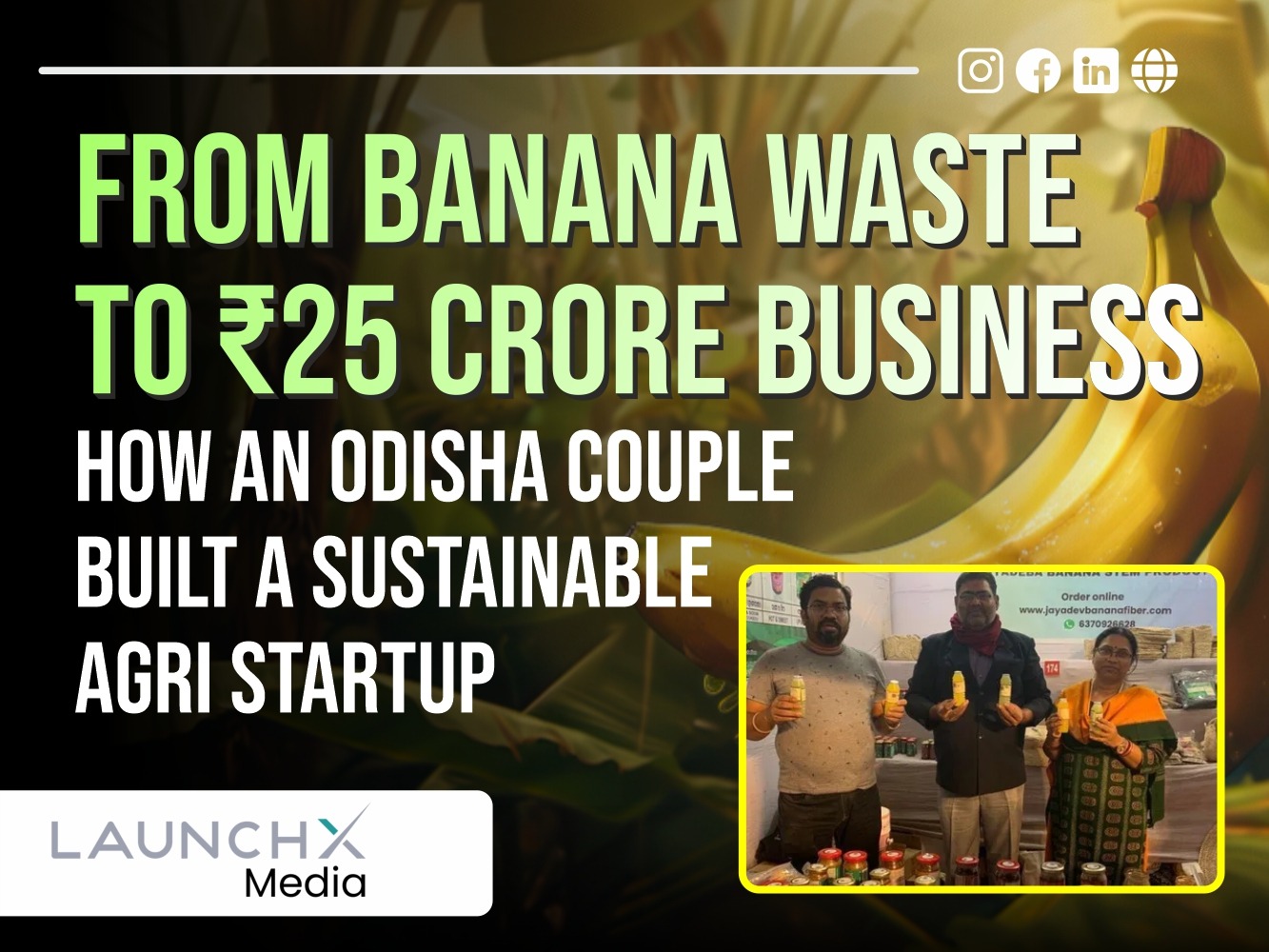

From Banana Waste to ₹25 Crore Business: How an Odisha Couple Built a Sustainable Agri Startup
Odisha Couple Turns Banana Waste into ₹25 Cr Agri-Business by Empowering 1000 Farmers
In India’s vast agricultural landscape, innovation often begins where others see only waste. That belief powered an Odisha-based couple to turn discarded bananas into a thriving food-processing enterprise, generating ₹25 crore in revenue in FY25 while uplifting more than 1,000 farmers.
- Odisha Couple Turns Banana Waste into ₹25 Cr Agri-Business by Empowering 1000 Farmers
- Seeing Opportunity in “Inauspicious” Bananas
- Building a Farmer-First Value Chain
- Turning Banana Waste into High-Demand Products
- Scaling With Sustainability at the Core
- Revenue Milestone: ₹25 Crore in FY25
- Empowering Rural India Beyond Income
- Why This Story Matters for Indian Agriculture
- Frequently Asked Questions (FAQs)
This is not just a farming success story—it’s a blueprint for sustainable agriculture, rural entrepreneurship, and circular economy innovation.
Seeing Opportunity in “Inauspicious” Bananas
When Waste Became the Idea
In many parts of Odisha, bananas rejected due to size, shape, or cultural beliefs are often dumped or left to rot. Despite being nutritionally rich, these bananas rarely reach markets.
Instead of ignoring the problem, the couple saw a hidden opportunity:
What if rejected bananas could become premium food products?
That simple question laid the foundation for a powerful agri-business model.

Building a Farmer-First Value Chain
Partnering With 1,000+ Farmers Across Odisha
Rather than sourcing raw materials through middlemen, the founders directly partnered with local banana farmers. This approach delivered two immediate benefits:
Farmers received fair and stable pricing for rejected produce
Agricultural waste was reduced at the source
By FY25, the startup had onboarded over 1,000 small and marginal farmers, creating a reliable supply chain rooted in trust.

Turning Banana Waste into High-Demand Products
Pickles, Jams, Papads & More
Using traditional recipes blended with modern food-processing techniques, the startup developed a range of value-added products, including:
Raw banana pickles
Banana-based jams
Banana papads
Specialty regional condiments
Each product emphasized clean ingredients, minimal preservatives, and authentic taste, helping the brand stand out in India’s crowded FMCG space.
Scaling With Sustainability at the Core
Circular Economy in Action
What makes this business model exceptional is its circular economy approach:
Rejected bananas become raw material
Farmers earn additional income
Food waste is reduced
Consumers get nutritious products
Even banana peels and by-products are reused where possible, minimizing environmental impact.

Revenue Milestone: ₹25 Crore in FY25
From Rural Idea to Profitable Enterprise
What began as a small experiment has now grown into a ₹25 crore agri-food business. Strong demand from:
Urban health-conscious consumers
Regional distributors
Online marketplaces
has enabled rapid scale without compromising on sustainability.
Empowering Rural India Beyond Income
Women Employment & Local Processing Units
The startup also created local processing units near farming clusters, generating employment for rural women and youth. This decentralized model reduced logistics costs while strengthening village economies.
Why This Story Matters for Indian Agriculture
A Replicable Model for the Future
This Odisha-based venture highlights key lessons for India’s farming future:
Agricultural waste can be profitable
Farmer partnerships beat exploitative sourcing
Sustainability and scalability can coexist
Rural startups can compete nationally
As climate challenges grow, such resilient, waste-to-value models may define the next era of Indian agriculture.

Frequently Asked Questions (FAQs)
1. What products does the Odisha banana startup make?
It produces banana-based pickles, jams, papads, and traditional food items.
2. How many farmers are involved in this initiative?
Over 1,000 farmers across Odisha are part of the supply chain.
3. Why are bananas considered waste in this case?
Bananas rejected due to size, shape, or cultural beliefs often go unsold.
4. What was the startup’s revenue in FY25?
The company reported revenue of approximately ₹25 crore.
5. Is this a sustainable farming model?
Yes, it follows circular economy principles and reduces food waste.
6. How does this benefit farmers financially?
Farmers earn from produce that would otherwise be discarded.
7. Are the products sold online?
Yes, the brand uses both online and offline distribution channels.
8. Does the startup create rural employment?
Yes, especially for women through local processing units.
9. Can this model be replicated in other states?
Absolutely. The concept works wherever agricultural waste exists.
10. What makes this startup unique?
Its combination of farmer collaboration, sustainability, and profitability.


