

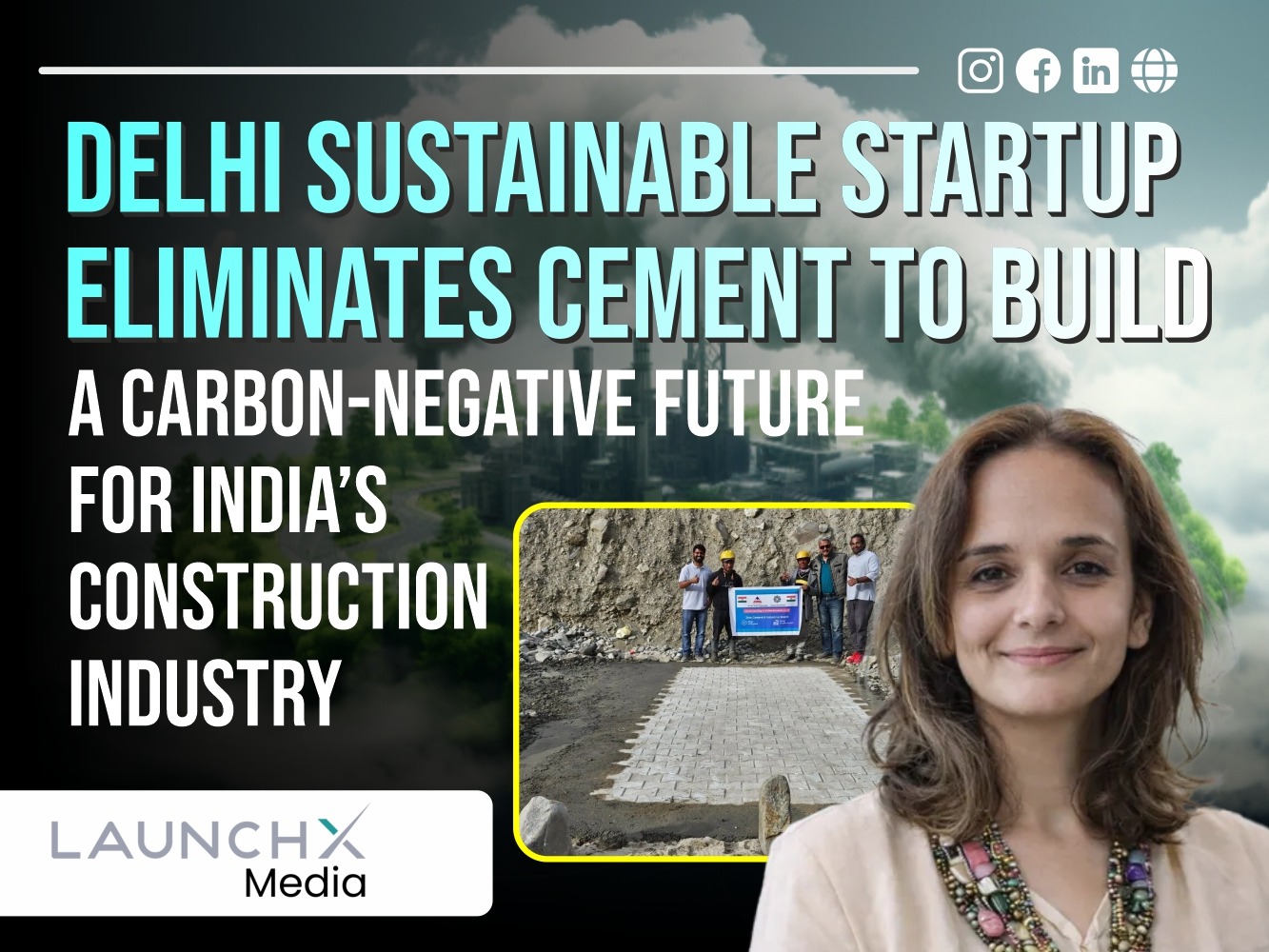

Delhi Sustainable Startup Eliminates Cement to Build a Carbon-Negative Future for India’s Construction Industry
Sustainable Construction Startup: 7 Powerful Ways This Delhi Company Is Killing Cement Pollution
India’s construction industry is growing at an unprecedented pace—new highways, airports, housing projects, and commercial spaces are rising every day. But behind this growth lies a silent environmental cost: cement, one of the world’s largest contributors to carbon emissions.
- Sustainable Construction Startup: 7 Powerful Ways This Delhi Company Is Killing Cement Pollution
- Why Cement Is One of the Biggest Climate Problems
- The Idea That Sparked a Sustainable Breakthrough
- What Makes This Cement-Free Material Different?
- Adoption by Large-Scale Infrastructure Projects
- Solving a Big Problem Without Slowing Development
- Building a Circular Economy in Construction
- Challenges in Disrupting a Legacy Industry
- The Future of Carbon-Negative Construction in India
- Why This Startup Matters
- FAQs (10)
Now, a Delhi-based sustainable startup is challenging this deeply entrenched system by doing what once seemed impossible—eliminating cement entirely from construction materials and replacing it with a carbon-negative alternative.
Their innovation is not just greener; it’s commercially viable, scalable, and already trusted by some of India’s largest infrastructure players.

Why Cement Is One of the Biggest Climate Problems
The Hidden Carbon Cost of Construction
Cement production alone contributes nearly 8% of global CO₂ emissions. In India, where infrastructure demand is exploding, cement has become both a necessity and an environmental liability.
Traditional construction materials consume enormous energy, rely heavily on mining, and release massive emissions during production. Despite awareness, alternatives have remained limited—until now.
This is the problem the Delhi startup set out to solve.
The Idea That Sparked a Sustainable Breakthrough
From Environmental Concern to Industrial Solution
The founders, coming from backgrounds in engineering and sustainability, were deeply concerned about the contradiction between India’s development goals and its climate commitments.
Rather than attempting incremental improvements to cement, they took a bolder approach—remove cement from the equation altogether.
After years of research, experimentation, and testing, they developed a proprietary construction material made from industrial by-products and natural binders that not only replaces cement but actively absorbs carbon from the atmosphere.

What Makes This Cement-Free Material Different?
Carbon-Negative by Design
Unlike traditional materials that add emissions to the environment, this innovation works in reverse.
Key characteristics include:
Zero cement usage
Utilization of industrial waste materials
Lower energy consumption during production
Ability to sequester carbon over time
Comparable strength and durability to conventional concrete
The result is a carbon-negative building material that fits seamlessly into existing construction workflows.
Adoption by Large-Scale Infrastructure Projects
From Pilot Projects to Industry Acceptance
Sustainable materials often struggle with adoption due to concerns around cost, reliability, and scalability. This startup addressed those concerns early.
By ensuring compatibility with existing construction practices and meeting strict quality benchmarks, the company successfully piloted its materials in real-world projects.
Today, the startup’s solutions are being used across commercial and industrial construction, proving that sustainability and scale can coexist.
Solving a Big Problem Without Slowing Development
Sustainability That Makes Business Sense
One of the startup’s biggest achievements is aligning environmental responsibility with commercial practicality.
Benefits for builders and developers include:
Reduced carbon compliance risk
Competitive pricing compared to premium green materials
Faster curing times in some applications
Alignment with ESG and sustainability goals
This makes adoption not just ethical—but economically sensible.

Building a Circular Economy in Construction
Turning Waste Into Value
A core part of the startup’s model is circularity. Industrial waste that would otherwise end up in landfills is repurposed into high-performance construction inputs.
This approach reduces:
Landfill dependency
Raw material extraction
Overall environmental footprint
At the same time, it creates a sustainable supply chain that benefits both industry and environment.
Challenges in Disrupting a Legacy Industry
Changing Mindsets, Not Just Materials
The construction sector is traditionally conservative. Introducing a cement-free alternative meant overcoming skepticism from engineers, contractors, and regulators.
The startup tackled this by:
Conducting extensive third-party testing
Demonstrating long-term durability
Working closely with policymakers and industry experts
Educating stakeholders on carbon-negative construction
Trust, built slowly, became their biggest asset.
The Future of Carbon-Negative Construction in India
From Alternative to Industry Standard
As India pushes toward net-zero targets, innovations like this are no longer optional—they are essential.
The startup plans to:
Expand manufacturing capacity
Enter new infrastructure segments
Collaborate with urban development bodies
Support India’s green building transition
Their long-term vision is to make cement-free construction the default, not the exception.
Why This Startup Matters
This Delhi-based startup represents a powerful shift in how India builds its future. Instead of choosing between development and sustainability, it proves that both can move forward together.
By eliminating cement and embracing carbon-negative materials, the company isn’t just reducing emissions—it’s redefining what responsible growth looks like.

FAQs (10)
1. What is carbon-negative construction?
It refers to materials or processes that absorb more carbon than they emit.
2. Why is cement harmful to the environment?
Cement production releases large amounts of CO₂ during manufacturing.
3. Is cement-free construction as strong as traditional concrete?
Yes, when engineered correctly, it meets structural and durability standards.
4. Can this material be used in large infrastructure projects?
Yes, it is already being used in commercial and industrial projects.
5. Is carbon-negative construction more expensive?
Not necessarily; costs are competitive with traditional materials.
6. What raw materials are used instead of cement?
Industrial by-products and natural binders are key components.
7. Does this material require new construction methods?
No, it integrates into existing construction workflows.
8. How does this help India’s climate goals?
It significantly reduces emissions from the construction sector.
9. Is this solution scalable across India?
Yes, the model is designed for large-scale adoption.
10. Will cement-free construction become mainstream?
As regulations and awareness grow, adoption is expected to accelerate.


