

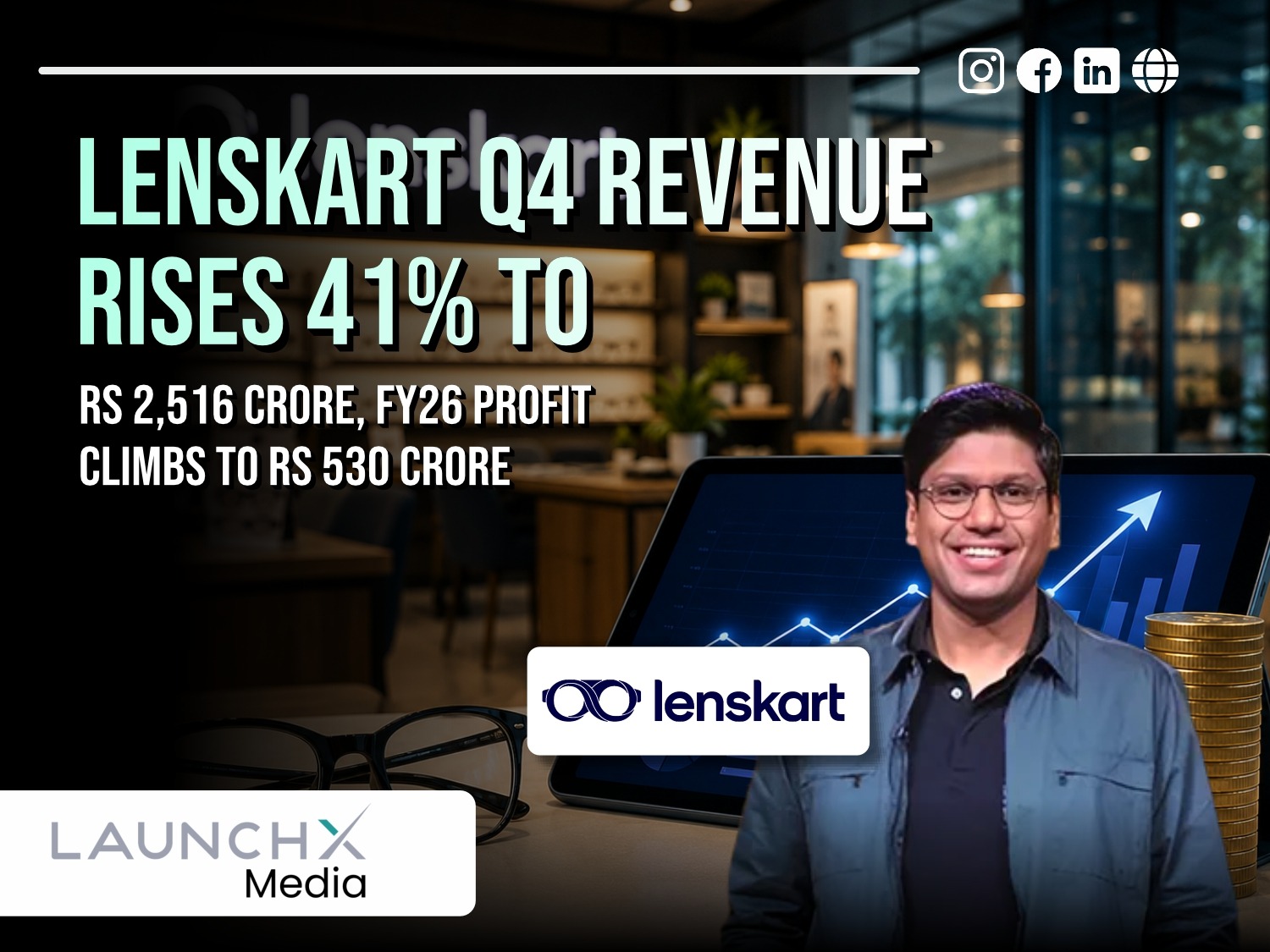

Lenskart Q4 Revenue Rises 41% to Rs 2,516 Crore, FY26 Profit Climbs to Rs 530 Crore
Lenskart Q4 Revenue Jumps 41% to Rs 2516 Crore as FY26 Profit Reaches Rs 530 Crore
India’s Eyewear Giant Continues Strong Growth Momentum
Lenskart has reported impressive financial results for FY26, with Q4 revenue rising 41% to Rs 2,516 crore while annual profit climbed to Rs 530 crore. The strong performance highlights the company’s growing dominance in India’s eyewear and omnichannel retail market.
- Lenskart Q4 Revenue Jumps 41% to Rs 2516 Crore as FY26 Profit Reaches Rs 530 Crore
- India’s Eyewear Giant Continues Strong Growth Momentum
- Revenue Growth Reflects Expanding Consumer Demand
- Eyewear Is Becoming Both a Necessity and Lifestyle Product
- Omnichannel Strategy Has Become a Major Advantage
- Offline Stores Still Matter in India
- A Major D2C Success Story
- Digital-First Shopping Is Becoming Normal
- Smart Retail Is the Future
- The Market Is Becoming More Organized
- International Expansion Could Become a Major Growth Driver
- Scaling a Consumer Brand Comes With Complexity
- D2C Brands Are Redefining Retail
- 1. What revenue did Lenskart report in Q4 FY26?
- 2. How much profit did Lenskart earn in FY26?
- 3. What does Lenskart do?
- 4. Why is India’s eyewear market growing rapidly?
- 5. What is Lenskart’s business model?
- 6. Why is omnichannel retail important?
- 7. How does technology help Lenskart?
- 8. What challenges does Lenskart face?
- 9. Could Lenskart expand internationally?
- 10. Why is Lenskart important for India’s startup ecosystem?
The results also reflect broader shifts happening across India’s consumer economy, where digital-first brands are rapidly expanding through technology, retail innovation, and changing lifestyle preferences.
Over the last few years, Lenskart has evolved from an online eyewear startup into one of India’s most recognized consumer brands. Its growth story demonstrates how technology, affordability, branding, and omnichannel retail strategies can combine to create a scalable and profitable business.
The latest financial performance reinforces the growing demand for premium yet accessible eyewear products across India’s urban and emerging consumer markets.

Lenskart FY26 Financial Performance Explained
Revenue Growth Reflects Expanding Consumer Demand
Lenskart’s 41% jump in quarterly revenue indicates strong customer demand across multiple product categories.
Several factors may have contributed to this growth:
- Rising eyewear awareness
- Increasing screen-time-related vision issues
- Growth in premium eyewear demand
- Expansion of retail stores
- Strong online sales
- Repeat customer purchases
The company has benefited from India’s rapidly growing middle class and rising focus on personal style, health, and convenience.
Profitability Signals Business Maturity
One of the biggest highlights from Lenskart’s financial performance is the rise in profitability.
Achieving a profit of Rs 530 crore demonstrates:
- Strong operational efficiency
- Better inventory management
- Improved supply chain optimization
- Scalable retail operations
- Healthy customer retention
- Efficient omnichannel integration
Profitability is especially significant in India’s startup ecosystem, where many fast-growing consumer brands often prioritize expansion over earnings.
The Rise of India’s Eyewear Market
Eyewear Is Becoming Both a Necessity and Lifestyle Product
India’s eyewear industry has evolved rapidly over the past decade.
Eyewear is no longer viewed only as a medical necessity. It has increasingly become:
- A fashion accessory
- A lifestyle statement
- A personal branding element
- A digital lifestyle requirement
The growth of screen exposure due to smartphones, laptops, and remote work has also increased awareness about eye health.
Rising Disposable Income Is Driving Premiumization
Consumers today are more willing to spend on:
- Branded frames
- Blue light glasses
- Sunglasses
- Premium lenses
- Smart eyewear solutions
This trend has created major opportunities for organized eyewear retailers.
Understanding Lenskart’s Business Model
Omnichannel Strategy Has Become a Major Advantage
One of the key reasons behind Lenskart’s success is its omnichannel business model.
The company combines:
- Online shopping
- Physical retail stores
- Mobile app experiences
- Home eye checkups
- Virtual try-on technology
This integrated approach allows customers to move seamlessly between digital and offline experiences.
Technology Is Central to the Brand
Lenskart has heavily invested in:
- AI-powered recommendations
- Face-mapping technology
- Virtual eyewear trials
- Automated manufacturing
- Data-driven personalization
Technology has helped simplify the eyewear purchasing process, which was traditionally fragmented and inconvenient.
Retail Expansion Continues to Drive Growth
Offline Stores Still Matter in India
Despite strong e-commerce growth, physical retail continues to play a major role in India’s consumer market.
Many customers still prefer visiting stores for:
- Eye testing
- Product trials
- Frame fitting
- Personalized assistance
Lenskart’s rapid retail expansion has helped strengthen brand visibility and customer trust.
Tier-2 and Tier-3 Cities Are Becoming Key Markets
India’s smaller cities are increasingly contributing to consumer growth.
Demand is rising in non-metro markets because of:
- Higher internet penetration
- Growing middle-class spending
- Better brand awareness
- Increasing digital adoption
This creates long-term expansion opportunities for consumer brands like Lenskart.
Why Lenskart’s Growth Matters for India’s Startup Ecosystem
A Major D2C Success Story
Lenskart is often viewed as one of India’s most successful direct-to-consumer (D2C) brands.
Its growth demonstrates how Indian startups can build large-scale businesses through:
- Strong branding
- Technology integration
- Supply chain control
- Customer-centric design
- Omnichannel distribution
The company’s profitability also strengthens investor confidence in scalable consumer startups.
Startup Ecosystem Is Shifting Toward Sustainable Growth
India’s startup ecosystem has gradually moved from aggressive cash-burning strategies toward:
- Better unit economics
- Operational discipline
- Sustainable profitability
- Long-term scalability
Lenskart’s financial performance reflects this broader transition.
Consumer Behavior in India Is Evolving Rapidly
Digital-First Shopping Is Becoming Normal
Indian consumers are increasingly comfortable purchasing products online, including categories traditionally dominated by offline retail.
Factors driving this shift include:
- Faster deliveries
- Virtual product experiences
- Competitive pricing
- Easy return policies
- Better online trust
However, consumers still value physical experiences for high-involvement purchases like eyewear.
This is why omnichannel retail models are becoming highly effective.
Technology and AI Are Transforming Retail
Smart Retail Is the Future
Retail technology is rapidly changing customer experiences across industries.
Companies are increasingly using:
- Artificial intelligence
- Predictive analytics
- Personalized recommendations
- Smart inventory systems
- Computer vision technology
Lenskart’s investment in digital innovation has helped differentiate it from traditional eyewear retailers.
Automation Is Improving Efficiency
Modern manufacturing and logistics automation can help:
- Reduce delivery timelines
- Improve product consistency
- Lower operational costs
- Enhance scalability
This becomes especially important as companies expand nationally and internationally.
Competition in India’s Eyewear Industry Is Increasing
The Market Is Becoming More Organized
India’s eyewear sector is attracting increasing competition from:
- Global eyewear brands
- Fashion retailers
- Online eyewear startups
- Optical chains
- D2C consumer brands
To stay ahead, companies must continuously innovate in:
- Product design
- Customer experience
- Technology
- Pricing strategies
- Marketing
Consumer Expectations Are Rising
Modern buyers increasingly expect:
- Affordable premium products
- Fast delivery
- Personalized experiences
- Easy returns
- Stylish designs
Meeting these expectations requires strong operational execution.
Future Growth Opportunities for Lenskart
International Expansion Could Become a Major Growth Driver
As the brand strengthens its position in India, international markets may offer significant expansion opportunities.
Potential growth areas include:
- Southeast Asia
- Middle East
- Global online eyewear retail
- Smart eyewear technology
- AI-driven vision solutions
Smart Eyewear Could Become a Future Segment
The future eyewear market may increasingly include:
- Connected glasses
- AR-enabled eyewear
- Health-monitoring eyewear
- AI-assisted vision products
Technology integration could redefine the industry over the next decade.

Challenges Lenskart May Face
Scaling a Consumer Brand Comes With Complexity
Despite strong growth, scaling a nationwide omnichannel business presents challenges.
These include:
- Inventory management
- Retail operating costs
- Customer acquisition expenses
- Supply chain disruptions
- Competitive pricing pressure
Maintaining Brand Trust Is Essential
As customer volumes increase, maintaining:
- Product quality
- Service standards
- Delivery efficiency
- Customer satisfaction
becomes increasingly important.
India’s Consumer Brand Landscape Is Becoming Global
D2C Brands Are Redefining Retail
Indian startups are increasingly building globally competitive consumer brands.
Lenskart’s success reflects how Indian companies are now leveraging:
- Technology
- Branding
- Manufacturing capabilities
- Data analytics
- Omnichannel retail
to compete at scale.
The company’s growth story could inspire more startups across retail and consumer sectors.
Final Thoughts
Lenskart’s FY26 performance, marked by a 41% rise in Q4 revenue and Rs 530 crore profit, highlights the growing strength of India’s organized eyewear and omnichannel retail industry.
The company’s success reflects larger shifts in consumer behavior, where technology-driven experiences, digital convenience, and lifestyle-oriented products are reshaping purchasing patterns across India.
By combining strong branding, retail expansion, operational efficiency, and technology innovation, Lenskart has built one of India’s most successful modern consumer businesses.
As India’s middle class continues to expand and digital adoption deepens, the eyewear market could witness even stronger growth in the coming years. Companies capable of balancing affordability, quality, technology, and customer experience are likely to emerge as long-term leaders.
Lenskart’s journey demonstrates how Indian startups can evolve into profitable, scalable, and globally competitive consumer brands.

5. FAQs (10)
1. What revenue did Lenskart report in Q4 FY26?
Lenskart reported Q4 revenue of Rs 2,516 crore.
2. How much profit did Lenskart earn in FY26?
The company’s FY26 profit climbed to Rs 530 crore.
3. What does Lenskart do?
Lenskart is an omnichannel eyewear retailer offering glasses, sunglasses, contact lenses, and eye care services.
4. Why is India’s eyewear market growing rapidly?
Increasing screen usage, fashion awareness, and rising disposable incomes are driving growth.
5. What is Lenskart’s business model?
Lenskart operates through a combination of online sales, retail stores, eye checkups, and technology-enabled services.
6. Why is omnichannel retail important?
It allows customers to enjoy both online convenience and offline product experiences.
7. How does technology help Lenskart?
Technology improves virtual try-ons, personalized recommendations, manufacturing efficiency, and customer engagement.
8. What challenges does Lenskart face?
Competition, inventory management, customer acquisition costs, and operational scaling remain key challenges.
9. Could Lenskart expand internationally?
Yes, international markets may become a major future growth opportunity.
10. Why is Lenskart important for India’s startup ecosystem?
It is one of India’s leading profitable D2C and consumer-tech success stories.