

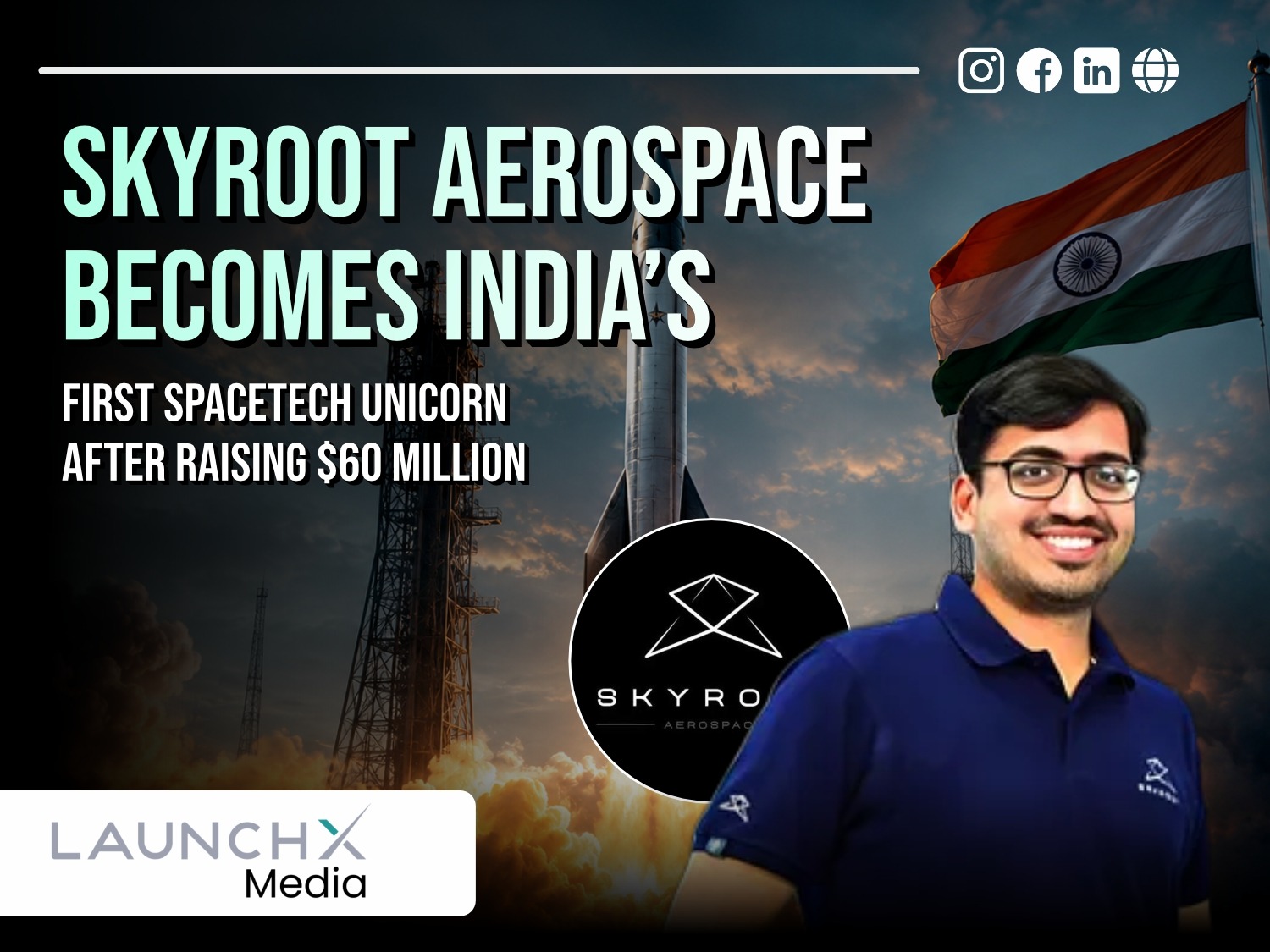

Skyroot Aerospace Becomes India’s First Spacetech Unicorn After Raising $60 Million
Skyroot Aerospace Becomes Indias First Spacetech Unicorn After Raising $60 Million
India’s startup ecosystem has achieved another historic milestone. Hyderabad-based spacetech company Skyroot Aerospace has officially entered the unicorn club after raising $60 million in fresh funding, becoming India’s first spacetech unicorn.
The achievement is more than just a funding milestone. It signals a major transformation in India’s private space industry and reflects growing investor confidence in deep-tech and aerospace innovation emerging from the country.
For years, the global space economy has been dominated by government agencies and a few global private players. But now, Indian startups are rapidly changing the narrative. Skyroot Aerospace’s rise shows that India is ready to become a serious force in the global commercial space race.

A Historic Moment for India’s Private Space Industry
The unicorn status marks a defining moment for the Indian spacetech sector. A unicorn startup is a privately held company valued at over $1 billion, and until now, no Indian spacetech startup had crossed this milestone.
Skyroot Aerospace reaching this valuation highlights how investors are increasingly viewing space technology not as a futuristic gamble, but as a commercially viable and high-growth industry.
The latest funding round is expected to help the company:
- Expand rocket development programs
- Strengthen manufacturing capabilities
- Accelerate satellite launch services
- Improve research and development
- Build advanced launch infrastructure
The announcement has generated excitement across India’s startup and technology ecosystem, especially among deep-tech founders and investors.
The Journey of Skyroot Aerospace
From Startup Vision to Unicorn Success
Founded by former aerospace engineers, Skyroot Aerospace started with a bold vision — to make space launches affordable, reliable, and accessible.
The company quickly gained attention for developing privately built launch vehicles designed specifically for small satellite deployment.
India’s growing satellite market created a strong opportunity for startups focused on low-cost and efficient launch systems. Skyroot identified this gap early and positioned itself as a next-generation private launch provider.
Over the years, the company focused heavily on:
- Rocket engineering
- Propulsion systems
- 3D-printed rocket components
- Cost-efficient launch technology
- Rapid launch turnaround systems
Its progress reflects how Indian startups are increasingly competing in sectors once considered impossible for private players.
Why the Funding Matters
Investor Confidence in India’s Deep-Tech Future
Raising $60 million in today’s market environment is a major achievement, especially in a capital-intensive industry like aerospace.
Unlike software startups, spacetech companies require massive investment in:
- Hardware
- Research
- Testing
- Infrastructure
- Manufacturing
- Safety systems
This funding round shows that investors are now willing to support long-term deep-tech innovation in India.
India’s Growing Space Economy
India’s space economy is projected to grow significantly over the next decade. The rise of private participation after regulatory reforms has created new opportunities in:
- Satellite launches
- Earth observation
- Space communications
- Defense technology
- Climate monitoring
- Space-based internet services
As demand for satellite deployment increases globally, companies like Skyroot Aerospace could become critical players in the international launch market.
The Rise of Private Space Startups in India
A New Era After ISRO Reforms
For decades, India’s space activities were largely controlled by the government through ISRO. However, recent policy reforms opened the doors for private startups to participate actively in the sector.
This policy shift created an entirely new startup ecosystem around:
- Rocket manufacturing
- Satellite systems
- Launch services
- Space software
- Aerospace research
Skyroot Aerospace emerged as one of the biggest beneficiaries of this transformation.
The company’s success may encourage even more entrepreneurs to enter the spacetech industry.
Why Hyderabad is Becoming a Deep-Tech Hub
Beyond Bengaluru: India’s Expanding Innovation Landscape
Hyderabad is steadily becoming one of India’s strongest deep-tech and aerospace innovation hubs.
The city offers several advantages:
- Strong engineering talent pool
- Aerospace manufacturing ecosystem
- Government support
- Startup-friendly infrastructure
- Research institutions
- Lower operational costs compared to some metro cities
The rise of companies like Skyroot Aerospace further strengthens Hyderabad’s position in India’s high-tech startup ecosystem.
The Technology Behind Skyroot Aerospace
Building Affordable Rocket Launch Systems
One of Skyroot’s major goals is to reduce the cost and complexity of launching satellites into space.
Traditional rocket launches are extremely expensive and involve long preparation cycles. Modern spacetech startups are trying to solve this through:
- Modular rocket systems
- Reusable technologies
- Lightweight materials
- Advanced propulsion systems
- AI-driven simulations
- 3D printing
Skyroot has invested significantly in advanced engineering technologies to improve launch efficiency and reduce operational costs.
This approach aligns with global trends in the commercial space industry.
India’s Growing Commercial Space Opportunity
The Satellite Economy is Expanding Rapidly
The world is witnessing explosive growth in satellite deployment. Satellites are now essential for:
- GPS navigation
- Internet connectivity
- Weather forecasting
- Agriculture monitoring
- Disaster management
- Defense operations
- Financial systems
Small satellite launches are becoming particularly important because startups and enterprises increasingly need cost-effective deployment solutions.
This creates enormous opportunities for launch providers like Skyroot Aerospace.

Challenges Facing Spacetech Startups
Space Innovation is Expensive and Complex
Despite the excitement around spacetech, the industry remains one of the most difficult startup sectors.
Companies face challenges such as:
- Long development cycles
- Regulatory approvals
- High infrastructure costs
- Safety compliance
- Technical failures
- Capital-intensive operations
Unlike software products that can scale rapidly, space technology requires years of testing and engineering validation.
This makes Skyroot’s unicorn achievement even more significant.
India’s Position in the Global Space Race
Can India Become a Global Spacetech Leader?
India has several advantages in the global space industry:
- Cost-efficient engineering
- Strong scientific talent
- Growing startup ecosystem
- Government support
- Expanding digital economy
As commercial space activity grows globally, India could become a preferred destination for affordable launch services.
Companies like Skyroot Aerospace may play a key role in positioning India as a global spacetech powerhouse.
The Future of Skyroot Aerospace
What Comes Next?
The fresh funding is expected to accelerate the company’s future plans significantly.
Potential focus areas include:
- More commercial launches
- Advanced rocket development
- International partnerships
- Satellite deployment services
- Expansion into global markets
The company could also contribute to broader aerospace innovation in India by creating jobs, attracting talent, and building manufacturing capabilities.
Why This Story Matters Beyond Funding
Skyroot Aerospace becoming a unicorn is not just a startup success story.
It represents:
- India’s growing deep-tech maturity
- Rising confidence in private innovation
- Expansion of the startup ecosystem beyond software
- Increasing global interest in Indian technology companies
The success also inspires a new generation of entrepreneurs to explore industries beyond traditional sectors like fintech and e-commerce.
India’s future unicorns may increasingly emerge from:
- Aerospace
- AI
- Robotics
- Biotechnology
- Climate tech
- Semiconductor manufacturing
Conclusion
Skyroot Aerospace’s rise as India’s first spacetech unicorn marks a turning point for the country’s innovation economy.
The company’s $60 million funding round is not only a validation of its technology and vision but also a reflection of the massive opportunities emerging in India’s private space sector.
As India continues opening its space ecosystem to private participation, startups like Skyroot Aerospace could shape the future of commercial space technology both domestically and globally.
The achievement proves that Indian startups are no longer limited to software and digital services. They are now entering some of the world’s most advanced and strategically important industries.
India’s spacetech revolution has officially begun.

FAQs
- What is Skyroot Aerospace?
Skyroot Aerospace is a Hyderabad-based private spacetech startup focused on developing rocket launch systems and satellite deployment services.
- Why is Skyroot Aerospace in the news?
The company became India’s first spacetech unicorn after raising $60 million in funding.
- What is a unicorn startup?
A unicorn startup is a privately held company valued at more than $1 billion.
- How much funding did Skyroot Aerospace raise?
The company reportedly raised $60 million in its latest funding round.
- Why is India’s spacetech sector growing?
Government reforms, rising satellite demand, private sector participation, and investor interest are driving growth.
- What does Skyroot Aerospace build?
The company develops launch vehicles, rocket technologies, and satellite launch solutions.
- Why is spacetech considered a deep-tech industry?
Spacetech requires advanced engineering, research, manufacturing, and large-scale infrastructure investment.
- How does private space innovation help India?
It boosts technological advancement, creates jobs, strengthens manufacturing, and improves global competitiveness.
- What challenges do spacetech startups face?
High costs, long development cycles, technical risks, and regulatory requirements are major challenges.
- Can India become a global spacetech hub?
Yes. With strong engineering talent, cost advantages, and policy support, India has significant potential in the global space economy.


